
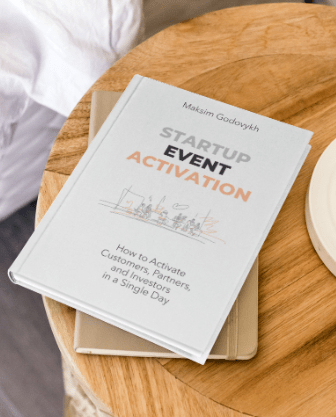
The book presents a practical execution framework for startup founders and innovation leaders, showing how well-designed events can be used as repeatable infrastructure to accelerate validation, partnerships, and investment.
Book Description
Most startups move slowly because they rely on fragmented tactics: marketing campaigns, sales calls, pitch decks, pilot programs, and meetings that rarely align. This book argues for a different approach. One that replaces scattered effort with a single execution environment where trust is built, decisions are made, and momentum is created in real time.
Based on 300+ high-stakes business events and years of building innovation pipelines and startup ecosystems, Startups and Events shows how one well-designed event can activate customers, partners, and investors at the same time. Not as a showcase. Not as a celebration. But as a system that performs multiple startup jobs in a single day.
This is not an event-planning book, a marketing playbook, or a startup manifesto. It is an execution guide for founders who need traction, validation, and commitment faster than traditional methods allow. You will learn why most startup events fail conceptually, how to design events as multi-function platforms, and how to engineer proof, agendas, and conversion moments that lead to real decisions.
The book walks you step by step through designing, executing, and reusing Activation Events across different stages, constraints, and industries. It shows how to compress trust, accelerate learning, replace months of outreach with hours of live interaction, and turn events into repeatable systems rather than one-off efforts. Each chapter advances a single Activation Event Plan and ends with clear actions you can apply immediately.
If you are building a startup, launching a product, activating a market, or aligning an ecosystem, this book offers a simple but radical idea: stop waiting until everything is ready. Start with an event.
Contents
PART 1. WHY EVENTS WORK FOR ALMOST EVERYTHING
Chapter 1: The Event as a Multi-Function Startup Platform
Chapter 2: Compression Mechanics: Trust, Attention, and Decisions
Chapter 3: The Activation Triangle
Chapter 4: Stages, Cases, and Constraints
PART 2. DESIGNING EVENTS THAT DELIVER STACKED OUTCOMES
Chapter 5: Matching Event Formats to Startup Tasks
Chapter 6: The Activation Sprint
Chapter 7: Proof Design and Narrative Architecture
Chapter 8: Logistics as a System, Not a Checklist
PART 3. EXECUTION, CONVERSION, AND REUSE
Chapter 9: The Single-Day Activation Event Blueprint
Chapter 10: Multi-Startup and Ecosystem Events
Chapter 11: Incentive Events and Strategic Relationship Activation
Chapter 12: Content, Media, and Amplification
PART 4. SYSTEMS, PROOF, AND THE FUTURE
Chapter 13: Common Failure Modes and How to Avoid Them
Chapter 14: Measuring What Matters
Chapter 15: Building a Repeatable Event System
Chapter 16: The Future of Startup Events
Appendix 1: The Event Activation Design Map
Appendix 3: Request for Reviews, Comments, Suggestions, and Ideas
Introduction
I have planned, organized, and executed over 300 major business events. These included investment forums where million-dollar deals were discussed, innovation showcases where startups met their first customers, trade shows where entire industries gathered to see what was next, boat shows and millionaire fairs where luxury manufacturers found their customers, career days where thousands of graduates explored their futures, and conventions where global organizations debated the direction of foresight. Each event was different in scale, audience, and purpose. Yet they all taught me the same lesson: events are not celebrations. They are execution environments.
I also had a unique opportunity to develop and lead some of the largest stage-gate innovation pipelines and startup ecosystems, working closely with the founders of thousands of projects we supported. Many founders treat events as optional, something to do after the product is built, after customers are acquired, and after funding is raised. In this mindset, events become a reward for progress rather than a tool for creating it. This is backward. The most successful initiatives I have launched, the ones that moved fastest and built the strongest momentum, all started with an event. Not a product launch. Not a marketing campaign. An event.
This approach is counterintuitive. It feels risky. It feels expensive. It feels like putting the cart before the horse. But it works. And it works because events create something that almost nothing else can create: compressed trust, shared context, and simultaneous decision-making across multiple stakeholders.
Why Credibility Resets in New Markets
When I moved to California, I learned something uncomfortable. My past achievements meant nothing. The events I had organized, the recognition I had received, the networks I had built—none of it transferred. In a new ecosystem, credibility resets to zero. No one cares what you did somewhere else. They care what you can do here, now, with them.
This is true for every founder entering a new market, every startup pivoting to a new customer segment, every innovator trying to build something that doesn’t yet exist. Past success does not guarantee future trust. Credentials do not replace proof. And proof, real proof, requires witnesses.
Events create witnesses. When you bring customers, partners, and investors into the same room and demonstrate value in real time, you are not asking people to believe your story. You are letting them see it unfold. This is why I always launch new initiatives with events. Not because I love logistics or enjoy public speaking, but because events are the fastest way to build credibility from zero.
Why Fragmented Tactics Slow Startups Down
Most startups operate in fragments. Customer discovery happens through one-on-one calls. Fundraising happens through pitch decks sent over email. Partnership conversations happen in coffee meetings. Marketing happens on social media. Hiring happens on job boards. Each activity is separate, sequential, and slow.
This fragmentation creates three problems. First, it wastes time. Every conversation requires context-setting, repetition, and follow-up. Second, it dilutes proof. When customers, partners, and investors never see each other, they cannot reinforce each other’s confidence. Third, it prevents learning. When feedback is scattered across dozens of private conversations, patterns are hard to see and insights are hard to capture.
Events solve all three problems. They compress time by bringing everyone together at once. They amplify proof by making validation public. They accelerate learning by making feedback observable. This is not theory. This is what I have seen happen, repeatedly, when events are designed correctly.
The Central Finding: Events Can Perform Many Startup Tasks at Once
Here is the core insight of this book. A well-designed event is not just a marketing tactic. It is a multi-function platform that can execute validation, research, alignment, proof, and conversion simultaneously. Instead of running these jobs separately over months, you can stack them into a single day.
This does not mean that events replace all other startup activities. You still need a product. You still need a business model. You still need discipline. But many of the activities that founders treat as separate and sequential can be collapsed into one high-intensity execution environment. When that happens, startups move faster.
The rest of this book is about how to design, plan, execute, and scale these environments. It is not about event planning in the traditional sense. It is about engineering outcomes. It is about turning a single day into a forcing function for decisions, commitments, and momentum.
What Makes This Book Different
There are many books about events. There are many books about marketing. There are many books about startups. This book sits at the intersection of all three, but it is not a synthesis. It is a system.
Most event books focus on logistics: how to pick a venue, how to manage vendors, how to create an agenda. Those things matter, but they are secondary. If the event has no clear job to perform, perfect logistics will not save it. Most marketing books focus on reach: how to attract attention, how to build a brand, how to go viral. Again, those things matter, but they are not enough. Attention without conversion is noise. Most startup books focus on strategy: how to find product-market fit, how to raise capital, how to scale. All true, but they treat execution as a separate problem.
This book treats execution as the primary problem. And it treats events as the solution. Not the only solution, but often the fastest one. The book is written from the perspective of someone who has been in the room when decisions were made, when partnerships were formed, when startups went from unknown to inevitable. I am not a theorist. I am an operator. Everything in this book is based on what I have seen work, what I have seen fail, and what I have learned from both.
How the Book, Course, and AI Event Builder Work Together
This book is not meant to be read in isolation. It is part of a system. The book provides the logic, the frameworks, and the mindset. The online course provides step-by-step guidance, templates, and examples. The AI Event Builder provides automation, personalization, and execution support.
You can use the book alone and still run a successful Activation Event. But the system is designed to work together. As you read each chapter, you will be prompted to use the AI Event Builder to generate plans, checklists, scripts, and timelines. The AI does not replace your judgment. It amplifies it. It handles the repetitive, the procedural, and the predictable, so you can focus on the strategic, the creative, and the human.
This integration is intentional. I have spent years watching founders struggle with event execution, not because they lacked ideas, but because they lacked systems. They knew what they wanted to achieve, but they didn’t know where to start, what to prioritize, or how to avoid common mistakes. The AI Event Builder solves that problem. It takes the frameworks from this book and turns them into executable plans.
What You Must Have by the End of This Introduction
Before you move to Chapter 1, you need three things. First, you need to identify one clearly stated bottleneck in your startup. Not a vague challenge like “we need more customers,” but a specific, measurable constraint like “we need three pilot customers in the healthcare vertical to validate our pricing model.” Second, you need to identify one high-stakes decision that you need to accelerate. Not a wish like “we want to raise funding,” but a decision like “we need to convince this specific investor to lead our seed round in the next 60 days.” Third, you need to open a blank document and title it “Activation Event Plan.”
This document will grow as you read the book. Each chapter will add a section. By the end, you will have a complete plan for your first Activation Event. But it starts here, with clarity about what you need to achieve and why an event is the right tool to achieve it.
If you cannot articulate your bottleneck, your decision, and your plan document, stop reading. Go back to your startup fundamentals. Events are force multipliers, not miracles. They amplify good strategy. They do not create it.
Why In-Person Trust Becomes More Valuable in an AI World
One final thought before we begin. As AI becomes more capable, more ubiquitous, and more trusted, the value of in-person interaction will increase, not decrease. This is counterintuitive. Many people assume that as digital tools improve, physical presence will matter less. I believe the opposite is true.
AI can draft emails, schedule meetings, analyze data, and generate content. But it cannot build trust. Trust is built through presence, through eye contact, through shared experience, through the small signals that humans read instinctively and unconsciously. When everyone can generate a perfect pitch deck with AI, the pitch deck stops being a differentiator. What differentiates is the ability to bring people together, to create shared context, and to facilitate decisions in real time.
This is why I am writing this book now. Because the window for event-driven competitive advantage is opening, not closing. Founders who understand how to design and execute Activation Events will move faster, build stronger networks, and create more durable businesses than those who rely solely on digital tactics.
PART I
WHY EVENTS WORK FOR ALMOST EVERYTHING
This part reframes events from marketing activities into execution environments. The chapters explain why events can replace or outperform fragmented startup tactics by compressing trust, attention, and decision-making. It introduces the event as a multi-function platform capable of handling promotion, validation, alignment, and conversion at once. The goal is to establish a clear mental shift before moving into design.
Chapter 1: The Event as a Multi-Function Startup Platform
Most startups don’t fail because they lack ideas. They fail because execution is fragmented. Customer discovery happens in one place. Fundraising happens in another. Partnership conversations live in inboxes. Marketing lives on social media. Hiring happens whenever there is time left. Each activity moves slowly, separately, and without shared context.
What I learned after producing and operating more than 300 business and innovation events is simple but uncomfortable for many founders to accept: a well-designed event can execute many startup jobs at the same time, faster and with less friction than running them separately. This is not about inspiration, branding, or “community building.” This is about execution efficiency.
When founders tell me that they ran an event and nothing happened, the problem is almost never logistics. The problem is that the event had no job to perform. Most startup events are designed backward. Founders pick a format like a demo day, meetup, or conference, invite people, and hope outcomes emerge. That’s not execution. That’s optimism. An event without explicit startup tasks is just a gathering. A gathering without tasks cannot produce decisions. And decisions are the only thing that moves a startup forward.
This is why I stopped thinking of events as formats and started treating them as platforms.
The Event as a Multi-Function Platform
A platform is not defined by how it looks. It is defined by what it enables. Your website is a platform. Your product is a platform. Your CRM is a platform. An Activation Event, when designed correctly, is also a platform, one that temporarily concentrates people, context, incentives, and authority into a single execution window. Inside that window, a startup can perform multiple jobs that usually take months.
In a single, well-structured event, I have repeatedly seen startups execute several critical functions simultaneously. Attraction means bringing the right people into a focused environment, not through advertising or cold outreach, but through strategic invitation and partner amplification. Validation means testing assumptions live, not through surveys or hypothetical questions, but by watching real customers interact with your product, hearing their objections in real time, and observing where they hesitate or commit. Research means capturing insights that you cannot get from a call or a form, insights that come from body language, from side conversations, from the questions people ask when they think you are not listening.
Alignment is one of the most underrated functions of an event. Startups often struggle because different stakeholders have different understandings of the problem, the solution, or the roadmap. An event forces alignment by putting everyone in the same room, hearing the same message, and reacting to the same demonstrations. When your internal team, your customers, and your partners all hear the same narrative at the same time, misalignment becomes visible and correctable immediately.
Ideation is another function that events enable in ways that asynchronous communication cannot. When you bring together customers, partners, and domain experts and facilitate a structured discussion about challenges and solutions, you are not just gathering opinions. You are co-creating. The best product features I have seen were not invented in isolation. They were invented in rooms where customers described their workflows, partners described their constraints, and founders synthesized both into something new.
Proof is perhaps the most powerful function of an event. Startups struggle with credibility because they are new, unproven, and asking people to take risks. An event creates proof in real time. When a customer describes their results on stage, that is proof. When a partner publicly commits to a co-marketing agreement, that is proof. When an investor sees three other investors leaning in during your demo, their perception of risk changes instantly. This is not manipulation. This is how human decision-making works. We evaluate risk and opportunity in context. Events create the context that isolated conversations cannot.
Conversion is the ultimate function. Everything else leads to this. Conversion means turning interest into commitment, turning conversations into contracts, turning curiosity into next steps. Most startup events fail at conversion because they treat it as something that happens after the event. They assume that networking will lead to follow-up emails, which will lead to meetings, which will eventually lead to deals. This is slow and fragile. A well-designed Activation Event treats conversion as something that happens during the event, in structured environments designed specifically for decision-making.
Most founders try to run these jobs sequentially. They spend weeks on attraction, then weeks on validation, then weeks on research, then weeks on conversion. Events allow you to stack them. This is not about doing things carelessly or superficially. It is about designing an environment where multiple functions can happen in parallel because the conditions are right.
The Concept of Stacked Outcomes
The concept of stacked outcomes is central to understanding why events work. When I say stacked, I mean that multiple startup functions happen in parallel, not in series. A traditional sales cycle might require you to spend one week attracting a lead, another week educating them, a third week validating their pain point, and a fourth week negotiating terms. In an Activation Event, all four happen in the same afternoon because the environment is designed to compress trust, attention, and decision-making into a single window.
Here is a concrete example. I once worked with a startup that was struggling to close pilot agreements with enterprise customers. They had a strong product, a clear value proposition, and a list of interested prospects. But every sales conversation took months. Prospects wanted references, case studies, and proof that the product worked in environments like theirs. The startup had none of these because they were too early. It was a classic chicken-and-egg problem.
We designed a half-day workshop for eight prospects. The agenda was simple. First, the founder presented the problem and the solution in 15 minutes. Then, we ran a live demonstration where prospects used the product to solve a real problem from their own workflows. Then, we facilitated a structured discussion where prospects shared their objections, constraints, and requirements. Finally, we broke into one-on-one sessions where the founder and each prospect discussed next steps.
By the end of the day, three prospects had signed pilot agreements. Two more scheduled follow-up meetings. The remaining three provided detailed feedback that shaped the product roadmap. This was not luck. This was outcome design. The event compressed what would have been six months of scattered sales conversations into four hours of structured interaction.
The key was stacking. While prospects were learning about the product, they were also validating their own pain points by hearing other prospects describe similar challenges. While the founder was demonstrating the product, he was also conducting research by observing where prospects struggled and where they succeeded. While prospects were discussing their objections, they were also building trust with each other and with the founder. And while the founder was closing pilots, he was also gathering proof that he could use with future prospects.
This is what I mean by a Multi-Function Platform. The event was not just a demo. It was not just a sales meeting. It was not just a research session. It was all of these at once, and the stacking made each function more effective.
Why Events Are Time Compressors
Time is the scarcest resource for a startup. What kills momentum is not failure. It is delay. Events compress time because they create three rare conditions simultaneously: shared context, dense attention, and social proof.
Shared context means that everyone in the room is hearing the same information at the same time. This eliminates the repetition and miscommunication that plague asynchronous communication. When you explain your value proposition in an email, the recipient reads it alone, without context, and often without full attention. When you explain it on stage, everyone hears it together, and their reactions reinforce each other. Questions that one person asks clarify confusion for others. Objections that one person raises get addressed publicly, which builds confidence for everyone.
Dense attention means that people are focused. In a well-designed event, distractions are minimized. Phones are down. Laptops are closed. People are present. This level of attention is almost impossible to achieve in a Zoom call or an email thread. Attention is the currency of trust. When someone gives you their full attention, they are signaling that you are worth their time. And when you deliver value during that attention window, trust builds faster than it ever could through fragmented interactions.
Social proof means that people are watching each other. Humans are social creatures. We evaluate risk and opportunity by observing how others react. When a potential customer sees another customer nodding during your demo, their confidence increases. When a potential partner sees an investor asking detailed questions, they perceive you as more credible. When an investor sees three customers describing their results, they perceive less risk. This is not manipulation. This is how trust works. Events create the conditions for social proof to operate at scale.
These three conditions, shared context, dense attention, and social proof, are why a 30-minute in-person conversation can replace weeks of email exchanges. An Activation Event deliberately engineers this compression. Instead of educating customers one by one, validating assumptions through scattered calls, and convincing partners in isolation, you do it once, together, under conditions designed for movement.
The Fragmentation Problem
Here is a hard truth founders rarely want to hear. Many early-stage startup activities exist only because there is no better execution environment. Endless discovery calls exist because feedback is fragmented. Pitch decks exist because proof is missing. Cold outreach exists because trust is absent. Events don’t eliminate these needs. They collapse them into one environment.
Instead of conducting 20 discovery calls, attending 15 pitch meetings, and sending 30 follow-up emails, you design one environment where feedback is public, proof is observable, and next steps are negotiated live. This does not replace discipline. It amplifies it. The discipline required to design an Activation Event is higher than the discipline required to send cold emails. But the return on that discipline is exponentially greater.
I have seen founders spend three months trying to schedule meetings with potential partners, only to have those meetings canceled or rescheduled repeatedly. I have also seen those same founders host a single half-day workshop where they brought together six potential partners, demonstrated their product live, facilitated a structured discussion about integration challenges, and walked away with three signed partnership agreements. The difference was not luck. It was environment design.
Fragmentation also creates information asymmetry. When you have 20 separate discovery calls, each prospect hears a slightly different version of your pitch. Each one asks different questions. Each one receives different answers. This inconsistency creates confusion and slows decision-making. In an event, everyone hears the same pitch, asks questions publicly, and hears the answers together. This consistency builds confidence and accelerates decisions.
Fragmentation also prevents learning. When feedback is scattered across dozens of private conversations, patterns are hard to see. You might hear the same objection five times without realizing it is a pattern because each conversation happened in isolation. In an event, patterns become visible immediately. When three prospects raise the same concern during a panel discussion, you know it is not an outlier. You know it is something you need to address. This real-time learning allows you to adapt your messaging, your product, and your strategy faster than any amount of post-hoc analysis.
Why Scale Is Secondary to Outcome Design
One of the most damaging myths in startup events is that bigger is better. It isn’t. I have seen 500-person conferences produce zero deals. I have seen 12-person workshops produce six pilots. I have seen small dinners unlock partnerships that months of outreach couldn’t. Scale is a multiplier, not a foundation. If your outcome logic is weak, scale only multiplies noise.
A Multi-Function Event Platform works at any size because it is anchored in jobs, not attendance. The right question is never:
“How many people can we attract?”
The right question is:
“What must change by the end of this day?”
If you are a seed-stage founder trying to validate product-market fit, a workshop with eight ideal customer profile representatives where you observe them using your product and capture their objections is infinitely more valuable than a webinar with 200 passive viewers. If you are trying to close a strategic partnership, a private dinner with the decision-maker and two of their trusted advisors is more valuable than a booth at a trade show.
This does not mean that large events are useless. It means that large events must be designed with the same outcome discipline as small ones. A 500-person conference can work if it is structured to create multiple parallel conversion environments. Breakout sessions, office hours, matchmaking zones, and closing rooms can turn a large event into dozens of small, high-intensity interactions. But if the event is just a series of keynote speeches with no structured interaction, size becomes a liability. Large passive audiences are expensive to attract, difficult to manage, and unlikely to convert.
I have also seen founders avoid events because they assume they need scale to make it worthwhile. They think that unless they can fill a ballroom, the event is not worth doing. This is wrong. Some of the highest-return events I have organized had fewer than 20 people. What mattered was not the size of the room, but the quality of the outcomes. If you bring together the right people, with the right incentives, in the right structure, size is irrelevant.
The Conceptual Failure of the Standard Event
Why do most startup events fail? It’s rarely because the catering was bad or the microphones cut out. They fail because they are conceptually hollow. Founders often fall into the trap of what I call the Event-as-Infomercial. They stand on a stage, pitch a deck that everyone has already seen on LinkedIn, and hope that networking will magically result in a check or a contract. This approach treats the audience as passive observers.
A true Activation Event treats the audience as active participants in a system. If you are struggling with customer validation, you don’t run a webinar. You run a hands-on clinic where you watch them struggle with your UI in real time. If you are struggling with partner alignment, you don’t send a PDF. You host a closed-door council where you co-create the roadmap. If you are struggling with investor confidence, you don’t pitch. You demonstrate live proof with customers and partners vouching for you in the room.
The shift from passive to active is not just about engagement. It is about evidence. Passive events produce opinions. Active events produce data. When a potential customer sits through your demo and then immediately schedules a pilot, that is data. When a partner publicly commits to co-marketing during a panel, that is data. When an investor asks for your term sheet after watching three customers describe their results, that is data.
The Event-as-Infomercial fails because it asks people to make decisions based on claims. The Activation Event succeeds because it asks people to make decisions based on evidence. And evidence, real evidence, requires participation. You cannot prove that your product works by talking about it. You prove it by letting people use it. You cannot prove that your customers are satisfied by showing a testimonial slide. You prove it by putting a customer on stage and letting them speak unscripted. You cannot prove that your partnerships are real by listing logos. You prove it by having partners in the room, publicly committing to next steps.
This is why I am so insistent on the concept of the event as a platform. A platform is not a stage. A stage is where you perform. A platform is where others perform. When you design an event as a platform, you are not the star. Your customers are the stars. Your partners are the stars. Your product, demonstrated live and unscripted, is the star. You are the orchestrator. You create the conditions for proof to emerge. And when proof emerges, trust follows.
The Core Shift: From Planning Events to Engineering Execution
Once you accept the event as a platform, everything changes. You stop asking what the agenda should be and start asking what execution steps must occur live. You stop measuring success by attendance and start measuring it by movement. You stop copying formats and start designing systems.
This is the mindset that underpins the rest of the book. Every chapter that follows is built on this foundation. We will explore how to design events that compress trust and accelerate decisions. We will examine how to structure events for multiple stakeholders without diluting outcomes. We will walk through the mechanics of planning, promoting, executing, and following up on Activation Events. We will look at how accelerators, universities, and cities use events to build innovation infrastructure. And we will explore how AI can automate much of the operational burden while preserving the human judgment that makes events work.
But all of that depends on accepting the premise of this chapter. Events are not marketing. They are execution environments. They are platforms. And when designed correctly, they are the fastest way to move a startup forward.
Summary
- Most startup events fail because they lack a specific execution job and treat the audience as passive observers.
- An Activation Event is a Multi-Function Startup Platform that stacks critical tasks like validation, research, alignment, and conversion into a single window.
- Events act as time compressors by creating shared context, dense attention, and social proof that cannot be replicated in fragmented digital communication.
- Fragmentation in startup tactics (separate calls, emails, and pitches) slows down momentum and dilutes the power of social proof.
- Outcome design is more important than scale; a small, structured event with the right stakeholders is more valuable than a large, passive audience.
- The core shift for founders is moving from “planning an event” to “engineering an execution environment” where decisions happen live.
Chapter 2: Compression Mechanics: Trust, Attention, and Decisions
The question I hear most often from founders is not whether events work. Most founders intuitively understand that bringing people together creates value. The question they ask is why events work. What is the underlying mechanism that makes a single day more powerful than weeks of emails, calls, and meetings? The answer lies in three compression mechanics: trust compression, attention density, and decision acceleration.
Understanding these mechanics is not academic. It changes how you design every element of your event. When you understand why trust builds faster in person, you stop wasting time on generic networking and start engineering specific trust-building moments. When you understand why attention density matters, you stop tolerating distractions and start designing environments that demand focus. When you understand why decisions accelerate in groups, you stop hoping for follow-up and start creating decision windows during the event itself.
These three mechanics are not separate. They reinforce each other. Trust enables attention. Attention enables learning. Learning enables decisions. And decisions, made publicly in the presence of peers, create social proof that accelerates trust for everyone else in the room. This is the flywheel that makes Activation Events work.
Trust Compression and Why Time Collapses in Person
Trust is not binary. It is not something you either have or don’t have. Trust is a gradient, and it builds through repeated exposure, consistency, and evidence. In a traditional business relationship, trust builds slowly. You meet someone. You exchange emails. You have a call. You meet again. Over weeks or months, you accumulate enough evidence to decide whether this person is credible, reliable, and worth your time.
Events compress this timeline by concentrating evidence. Instead of accumulating trust signals over weeks, you accumulate them over hours. Every interaction, every observation, every third-party validation adds to the evidence. When you see someone present on stage, you are evaluating their competence. When you see how they handle a difficult question, you are evaluating their honesty. When you see other people you respect engaging with them, you are evaluating their credibility. All of this happens simultaneously, in real time, without the delays and friction of asynchronous communication.
This is why a 30-minute in-person conversation can replace weeks of email exchanges. It is not that the conversation covers more ground. It is that the conversation happens in a context-rich environment where trust signals are abundant and immediate. You are not just hearing words. You are observing body language, tone, eye contact, and social dynamics. You are seeing how this person interacts with others. You are watching how they respond to challenges. All of these signals contribute to trust, and all of them are absent or diminished in digital communication.
There is also a psychological dimension to trust compression. When you meet someone in person, especially in a professional setting where you have both invested time and effort to be present, there is an implicit commitment. You are signaling that this relationship is worth your attention. This signal is much weaker in a Zoom call, where the barrier to entry is low and the cost of disengagement is minimal. In-person presence is a costly signal, and costly signals are more credible.
I have seen this play out repeatedly. A founder spends months trying to get a meeting with a potential investor. Emails go unanswered. LinkedIn messages are ignored. But when that same founder meets the investor at an event, has a 10-minute conversation, and demonstrates credibility in a context where other credible people are present, the investor agrees to a follow-up meeting. The difference is not the pitch. The difference is the trust compression that happens when context, evidence, and social proof align.
Attention Density vs Asynchronous Communication
Attention is the scarcest resource in modern business. Everyone is overwhelmed. Inboxes are full. Calendars are packed. Notifications are constant. In this environment, getting someone’s full attention is nearly impossible. Even when you schedule a call or a meeting, you are competing with email, Slack, and the dozens of other things demanding attention.
Events create attention density by removing distractions and creating a shared focus. When someone attends an event, they have made a decision to be present. They have blocked time. They have traveled. They have committed. This commitment creates a psychological contract: I am here, and I will pay attention. This contract is much stronger than the implicit agreement of a Zoom call, where the barrier to multitasking is low and the social cost of distraction is minimal.
Attention density also creates a feedback loop. When everyone in the room is paying attention, the quality of the conversation improves. Questions are sharper. Objections are more thoughtful. Insights are deeper. This higher-quality interaction reinforces attention. People stay engaged because the conversation is worth engaging with. This is the opposite of what happens in asynchronous communication, where low engagement leads to shallow responses, which leads to even lower engagement.
I have run workshops where participants put their phones in a box at the door. The first reaction is always resistance. People are uncomfortable being disconnected. But within 20 minutes, the quality of the conversation changes. People are present. They are listening. They are building on each other’s ideas. By the end of the session, most participants say it was the most productive conversation they have had in months. The only thing that changed was attention density.
Attention density also enables real-time learning. In asynchronous communication, feedback is delayed. You send an email, wait for a response, adjust your message, and send another email. This loop can take days or weeks. In an event, feedback is immediate. You say something, and you see the reaction instantly. You adjust in real time. This rapid iteration is how you refine your message, your product, and your strategy faster than your competitors.
Decision Speed and Social Proof
Decisions are social. We like to think of ourselves as rational, independent thinkers, but the reality is that most decisions are influenced by what we see others doing. This is not a weakness. It is an evolutionary adaptation. In uncertain environments, observing the behavior of others is a reliable way to assess risk and opportunity. Events leverage this by making decisions visible and social.
When a potential customer sees another customer commit to a pilot, their perception of risk changes. When a potential partner sees an investor asking detailed questions, they perceive the startup as more credible. When an investor sees three other investors leaning in during a demo, they perceive less risk. This is social proof in action, and it is one of the most powerful mechanisms for accelerating decisions.
Social proof works because it provides evidence that is independent of the founder’s claims. A founder can say their product works, but that is a claim. A customer can say the product works, and that is evidence. But when a customer says the product works in front of other potential customers, and those potential customers see the founder’s reaction, and they see other people nodding in agreement, that is social proof. It is evidence that has been validated by the group.
Events also create decision windows. In normal business interactions, decisions can be delayed indefinitely. There is always a reason to wait, to gather more information, to consult with others. Events create urgency by concentrating decision-making into a finite window. When you are in a room with the decision-maker, and the opportunity to commit is now, the cost of delay becomes visible. This urgency, combined with social proof, accelerates decisions that might otherwise take weeks or months.
I have seen this work in high-stakes environments. A startup was trying to close a partnership with a large enterprise. The enterprise had been evaluating the partnership for six months. Every time the startup thought they were close, the enterprise asked for more information, more references, more proof. We organized a half-day executive session where the startup brought in three existing customers, demonstrated the product live, and facilitated a discussion about implementation challenges. By the end of the session, the enterprise committed to a pilot. The difference was not the information. The enterprise had all the information they needed. The difference was the decision window and the social proof.
Why Validation, Research, and Strategy Work Better Live
Validation is not about asking people if they like your idea. Validation is about observing behavior. Do people use your product? Do they pay for it? Do they recommend it to others? These are the signals that matter, and they are much easier to observe in person than through surveys or interviews.
When you run a live demonstration at an event, you are not just showing your product. You are watching how people interact with it. Where do they hesitate? What questions do they ask? What features do they ignore? This behavioral data is far more valuable than survey responses because it is unfiltered and immediate. People can lie in surveys, either to be polite or because they don’t know what they actually want. But behavior doesn’t lie.
Research works better live for the same reason. When you facilitate a discussion with customers, partners, and domain experts, you are not just collecting opinions. You are observing dynamics. Who defers to whom? What objections get raised? What assumptions get challenged? These dynamics reveal insights that you cannot get from individual interviews because individual interviews lack the social context that shapes real-world decision-making.
Strategy also benefits from live interaction. Strategy is not just about analysis. It is about alignment. When your team, your customers, and your partners all hear the same information at the same time, and they react to it together, alignment happens faster. Misunderstandings get corrected immediately. Objections get addressed publicly. Commitments get made in front of witnesses. This shared experience creates a foundation for execution that is much stronger than anything you can build through documents or presentations.
The Proper Role of Digital Tools
I am not anti-digital. Digital tools are essential for modern business. But they are not a replacement for in-person interaction. They are a complement. The proper role of digital tools is to support the event, not replace it.
Before the event, digital tools are useful for outreach, scheduling, and logistics. You can use email and social media to invite people. You can use scheduling tools to coordinate calendars. You can use project management tools to track tasks. All of this is valuable, and all of it should be automated as much as possible.
During the event, digital tools should be minimal. The goal is presence and attention. Laptops should be closed. Phones should be away. The only digital tools that should be active are those that directly support the event experience: presentation software, live polling, collaborative documents. Even these should be used sparingly. The more you rely on screens, the less you benefit from the attention density and social proof that make events powerful.
After the event, digital tools become essential again. Follow-up emails, scheduling tools, CRM systems, content distribution platforms—all of these are critical for converting event momentum into long-term relationships. But the event itself should be as analog as possible. The power of events comes from human connection, and human connection is diminished by digital mediation.
I have seen founders make the mistake of trying to “enhance” their events with too much technology. Live streaming, virtual reality, interactive apps—all of these can add value in specific contexts, but they can also distract from the core purpose of the event. The question to ask is not “What technology can we use?” but “What outcome are we trying to achieve, and does this technology help or hinder that outcome?”
Summary
- Trust compression happens when evidence accumulates rapidly through in-person interaction, body language, and social context that digital communication cannot replicate.
- Attention density is created when participants commit to being fully present, enabling higher-quality conversations and real-time learning.
- Decision speed accelerates through social proof, where visible commitments by peers reduce perceived risk and create urgency within finite decision windows.
- Validation, research, and strategy are more effective live because they rely on observable behavior and group dynamics rather than self-reported data.
- Digital tools should support events through pre-event logistics and post-event follow-up, but should be minimized during the event to preserve attention and human connection.
Chapter 3: The Activation Triangle
One of the most common mistakes founders make when designing events is trying to serve everyone with the same agenda. They invite customers, partners, and investors to the same event, put everyone in the same room, and deliver a generic presentation that tries to appeal to all three audiences. This approach fails because customers, partners, and investors evaluate risk differently, care about different outcomes, and need different types of proof.
The Activation Triangle is a framework for designing events that serve multiple stakeholders without diluting outcomes. The core insight is simple: customers, partners, and investors can attend the same event, but they need parallel value paths. Each stakeholder group should have a clear reason to attend, a clear set of outcomes they can achieve, and a clear next step they can take. When these parallel paths are designed correctly, they reinforce each other. Customers provide proof for investors. Partners provide distribution for customers. Investors provide credibility for partners. This is how you turn a single event into a multi-stakeholder activation engine.
Why Customers, Partners, and Investors Evaluate Risk Differently
Customers evaluate risk by asking whether your product will solve their problem without creating new problems. They care about functionality, reliability, support, and cost. They want to see proof that your product works in environments like theirs. They want to talk to other customers who have used the product successfully. They want to understand what happens if something goes wrong. Their decision is primarily operational.
Partners evaluate risk by asking whether working with you will help them achieve their goals without damaging their reputation. They care about alignment, capacity, and mutual benefit. They want to see proof that you can execute, that you understand their constraints, and that you will not create problems for their customers. They want to understand how the partnership will work in practice, who will do what, and how success will be measured. Their decision is primarily strategic.
Investors evaluate risk by asking whether your startup will generate returns without requiring excessive time or capital. They care about market size, traction, team quality, and competitive positioning. They want to see proof that customers want your product, that you can acquire customers efficiently, and that you can scale. They want to understand your business model, your unit economics, and your path to profitability. Their decision is primarily financial.
These are fundamentally different evaluation frameworks. A demo that convinces a customer might bore an investor. A financial projection that excites an investor might confuse a customer. A partnership proposal that appeals to a partner might be irrelevant to both customers and investors. This is why generic presentations fail. They try to address all three frameworks at once and end up addressing none of them well.
Why Most Events Fail by Mixing Audiences Without Structure
The typical startup event puts everyone in the same room and delivers the same content to everyone. The founder stands on stage and pitches the product. The pitch includes a problem statement, a solution overview, a demo, some traction metrics, and a call to action. The audience listens politely, asks a few questions, and then networks over coffee. Some business cards are exchanged. Some follow-up emails are sent. But very few commitments are made.
This approach fails because it treats the event as a broadcast, not a platform. The founder is transmitting information, and the audience is receiving it. There is no structure for interaction, no mechanism for validation, and no clear path from interest to commitment. Customers leave without understanding how to get started. Partners leave without understanding how to collaborate. Investors leave without understanding what the ask is.
The problem is not the content. The problem is the structure. When you mix audiences without creating parallel value paths, you force everyone to sit through content that is only partially relevant to them. Customers sit through financial projections. Investors sit through product demos. Partners sit through customer testimonials. Everyone is polite, but no one is fully engaged. And without engagement, there is no conversion.
I have seen this pattern repeatedly. A founder invites 50 people to an event. The audience includes 20 potential customers, 15 potential partners, and 15 potential investors. The founder delivers a 30-minute presentation that tries to address all three groups. At the end, a few people ask questions, but most people are checking their phones. During the networking session, a few conversations happen, but they are shallow and unfocused. A week later, the founder follows up with everyone, but the response rate is low. The event generated awareness, but it did not generate activation.
Parallel Value Paths in One Environment
The solution is to design parallel value paths within the same event. This does not mean running three separate events. It means structuring the agenda so that each stakeholder group has moments that are specifically designed for them, while also creating moments where all three groups interact in ways that reinforce each other.
Here is how this works in practice. The event starts with a shared narrative that establishes context for everyone. This is not a pitch. It is a framing. You explain the problem you are solving, why it matters, and why now is the right time. This narrative should be relevant to all three groups, but it should not try to sell anything. It should create shared understanding.
After the shared narrative, the agenda splits into parallel tracks. Customers go to a hands-on workshop where they use the product to solve a real problem. Partners go to a strategy session where they discuss integration opportunities and go-to-market alignment. Investors go to a deep-dive session where they review traction data, unit economics, and growth strategy. Each track is designed to address the specific evaluation framework of that stakeholder group.
After the parallel tracks, the agenda reconvenes for a shared proof session. This is where customers, partners, and investors come back together and hear from each other. A customer presents their results from the workshop. A partner describes their integration plan. An investor asks questions about scalability. This shared proof session is where social proof happens. Customers see that investors are interested, which increases their confidence. Investors see that customers are engaged, which reduces their perception of risk. Partners see both, which increases their willingness to commit.
Finally, the agenda splits again for conversion sessions. Customers meet one-on-one with the sales team to discuss onboarding. Partners meet with the business development team to draft partnership agreements. Investors meet with the founder to discuss terms. These conversion sessions are structured, time-bound, and focused on next steps. The goal is not to close every deal on the spot, but to move every relationship forward in a concrete, measurable way.
This structure works because it respects the different evaluation frameworks of each stakeholder group while creating moments where those frameworks reinforce each other. Customers get the hands-on proof they need. Partners get the strategic alignment they need. Investors get the traction data they need. And all three groups see each other engaging, which creates social proof that accelerates decisions.
The Activation Scorecard as Outcome Logic
The Activation Scorecard is a tool for defining and measuring success for each stakeholder group. Before you design your event, you need to answer three questions for each group: What is the yes outcome? What proof do they need to say yes? What is the next step after yes?
For customers, the yes outcome might be signing up for a pilot, scheduling an onboarding call, or committing to a paid trial. The proof they need might be seeing the product work in a live demo, hearing from another customer in their industry, or understanding the support process. The next step might be a kickoff meeting, a technical integration call, or a contract signature.
For partners, the yes outcome might be agreeing to a co-marketing campaign, committing to a referral agreement, or scheduling a joint customer meeting. The proof they need might be understanding your customer base, seeing your go-to-market strategy, or hearing from a mutual customer. The next step might be a partnership agreement, a joint webinar, or a shared content calendar.
For investors, the yes outcome might be scheduling a diligence call, introducing you to a co-investor, or committing to a term sheet. The proof they need might be seeing customer traction, understanding your unit economics, or meeting your team. The next step might be a data room review, a reference call, or a follow-up meeting.
The Activation Scorecard forces you to be specific about what success looks like for each group. It prevents you from designing a generic event that tries to be everything to everyone. And it gives you a clear way to measure whether the event worked. If 50% of customers move to the next step, 30% of partners commit to collaboration, and 20% of investors schedule follow-up meetings, you know the event was successful. If those numbers are lower, you know you need to redesign the proof or the conversion process.
I use the Activation Scorecard for every event I design. It is the first thing I create, before I think about venues, speakers, or agendas. Because if I don’t know what success looks like for each stakeholder group, I have no way to design an event that delivers it.
Designing for Three Audiences Without Dilution
The challenge of designing for three audiences is avoiding dilution. If you try to make every moment relevant to every group, you end up making every moment mediocre for every group. The solution is to be intentional about when you bring groups together and when you separate them.
Bring groups together when the goal is shared context, social proof, or narrative alignment. The opening session should be shared because everyone needs to understand the problem and the solution. The proof session should be shared because social proof requires witnesses. The closing session should be shared because public commitments create accountability.
Separate groups when the goal is depth, specificity, or conversion. Customers need hands-on time with the product. Partners need strategic discussions about alignment. Investors need detailed financial analysis. These conversations are more effective when they happen in focused, homogeneous groups where everyone is evaluating the same framework.
The key is to design transitions between shared and separate moments. When you split the agenda into parallel tracks, explain why. Tell customers that they are going to a workshop so they can see the product in action. Tell partners that they are going to a strategy session so they can explore collaboration opportunities. Tell investors that they are going to a deep-dive so they can understand the business model. This transparency builds trust and ensures that everyone understands the structure.
When you bring groups back together, create moments where each group can share what they learned. This is where the parallel paths reinforce each other. A customer describes their experience in the workshop, and an investor hears proof of product-market fit. A partner describes their integration plan, and a customer hears proof of ecosystem support. An investor asks a tough question, and a partner hears proof of due diligence. These moments are where the Activation Triangle becomes more than the sum of its parts.
Summary
- Customers, partners, and investors evaluate risk through fundamentally different frameworks: operational, strategic, and financial.
- Most events fail by delivering generic content to mixed audiences, resulting in low engagement and minimal conversion.
- Parallel value paths allow each stakeholder group to receive targeted content while creating shared moments for social proof and narrative alignment.
- The Activation Scorecard defines specific yes outcomes, required proof, and next steps for each stakeholder group before the event is designed.
- Effective multi-stakeholder events alternate between shared sessions for context and social proof, and separate tracks for depth and conversion.
Chapter 4: Stages, Cases, and Constraints
Not all startups are the same. A pre-seed founder validating an idea faces different challenges than a Series A founder scaling a sales team. A healthcare startup navigating regulatory approval faces different constraints than a consumer app optimizing for viral growth. A hardware startup with long development cycles faces different timelines than a software startup shipping weekly updates. This means that there is no single “best” event format. The right event depends on your stage, your constraints, and your primary outcome.
This chapter is about making your event design robust across contexts. It is about understanding how to adapt the Activation Event framework to different stages of startup development, different industry constraints, and different resource limitations. The goal is not to provide a prescriptive playbook for every possible scenario. The goal is to teach you how to think about adaptation so that you can design the right event for your specific situation.
How Event Design Changes by Startup Stage
Startup stages are not just about funding rounds. They are about the primary bottleneck the startup is facing. A pre-seed startup is bottlenecked by validation. A seed-stage startup is bottlenecked by early traction. A Series A startup is bottlenecked by scaling. Each bottleneck requires a different type of event.
At the pre-seed stage, the primary goal is validation. You need to prove that the problem you are solving is real, that your solution is viable, and that customers will pay for it. The right event at this stage is small, focused, and interactive. A workshop with 8 to 12 ideal customer profile representatives where you demonstrate a prototype, observe their reactions, and capture their feedback is far more valuable than a large conference. The outcome you are looking for is not revenue. It is evidence. Do customers understand the problem? Do they see the value in your solution? What objections do they raise? What features do they care about? This evidence shapes your product roadmap and your go-to-market strategy.
At the seed stage, the primary goal is traction. You have validated the problem and the solution. Now you need to prove that you can acquire customers efficiently and that those customers will stay. The right event at this stage is designed for conversion. A demo day, a partner summit, or a customer showcase where you demonstrate proof of concept, share early traction metrics, and facilitate introductions between customers and partners. The outcome you are looking for is pipeline. How many qualified leads did you generate? How many pilots did you close? How many partnership conversations did you start? This traction proves to investors that you can execute and that the market is responding.
At the Series A stage, the primary goal is scaling. You have product-market fit. You have a repeatable sales process. Now you need to scale that process across geographies, verticals, or customer segments. The right event at this stage is designed for ecosystem activation. A multi-day conference, a regional roadshow, or a partner enablement summit where you bring together customers, partners, and ecosystem players to create a flywheel of growth. The outcome you are looking for is leverage. How many partners are now actively referring customers? How many customers are now advocating for your product? How much media coverage did you generate? This leverage allows you to scale faster than your competitors.
The key insight is that the event format should match the bottleneck. If you are bottlenecked by validation, a large conference is a waste of resources. If you are bottlenecked by scaling, a small workshop is insufficient. The right event is the one that removes your current bottleneck most efficiently.
How Constraints Affect Design
Every startup operates under constraints. Budget constraints limit how much you can spend on venues, catering, and promotion. Time constraints limit how much preparation you can do. Regulatory constraints limit what you can say and who you can invite. Sales cycle constraints limit how quickly you can convert attendees into customers. These constraints are not excuses. They are design parameters.
Budget constraints force you to focus on outcomes rather than production value. If you have a limited budget, you cannot afford a fancy venue, expensive catering, or professional event production. But you can afford a conference room, coffee, and a well-designed agenda. The question is not how much you can spend, but how much value you can create with what you have. I have seen founders run incredibly effective events in co-working spaces, university classrooms, and even restaurants. The venue does not create the value. The structure creates the value.
Time constraints force you to prioritize. If you only have two weeks to plan an event, you cannot build a complex multi-track agenda with dozens of speakers. But you can design a focused half-day workshop with a clear outcome. The question is not how much time you have, but what is the minimum viable event that achieves your goal. I have seen founders plan and execute successful events in less than a week because they were ruthlessly focused on a single outcome.
Regulatory constraints force you to be creative about proof. If you are in a regulated industry like healthcare or finance, you cannot make claims about efficacy or returns without evidence. But you can demonstrate workflows, share anonymized case studies, and facilitate discussions about challenges and solutions. The question is not what you can say, but what you can show. I have seen healthcare startups run events where they demonstrated their product in a simulated environment, allowing customers to see the value without making any regulatory claims.
Sales cycle constraints force you to design for long-term engagement rather than immediate conversion. If your sales cycle is six months or longer, you cannot expect to close deals at the event. But you can move prospects from awareness to consideration, from consideration to evaluation, and from evaluation to negotiation. The question is not whether you can close the deal today, but whether you can move the deal forward. I have seen enterprise software startups run events where the goal was not to close, but to get the prospect to agree to a proof of concept. That agreement, made publicly in front of peers, created momentum that carried through the rest of the sales cycle.
Why No Single Best Event Exists
The startup world loves best practices. Founders want to know what the best event format is, what the best agenda structure is, what the best promotion strategy is. But there is no single best event. There is only the best event for your specific stage, constraints, and outcome.
This is why copying other startups’ events often fails. You see a competitor run a successful demo day, so you run a demo day. But your competitor was at a different stage, with different constraints, and a different outcome. What worked for them does not work for you because the context is different. The solution is not to copy formats. The solution is to understand the principles that make events work and apply those principles to your specific context.
The principles are universal. Events work because they compress trust, create attention density, and accelerate decisions. Events work because they allow you to stack multiple startup jobs into a single window. Events work because they create social proof and shared context. These principles apply to every event, regardless of format, size, or industry.
The application is specific. A pre-seed healthcare startup validating a medical device will design a very different event than a Series A consumer app scaling user acquisition. But both events will be designed around the same principles. Both will focus on outcomes rather than production value. Both will create parallel value paths for different stakeholders. Both will measure success by movement, not attendance.
This is the mindset shift that this chapter is designed to create. Stop looking for the best event. Start designing the right event for your situation.
Mapping Event Types to Startup Stages
Here is a practical framework for thinking about which event types work best at which stages. This is not prescriptive. It is a starting point for your own design process.
Pre-seed and idea stage: workshops, focus groups, prototype demos, office hours. The goal is validation and feedback. The format should be small, interactive, and focused on learning. You are not trying to impress anyone. You are trying to learn whether your idea is worth pursuing.
Seed stage and early traction: demo days, pilot showcases, partner summits, investor salons. The goal is conversion and traction. The format should be structured around proof and next steps. You are not trying to educate anyone. You are trying to move them from interest to commitment.
Series A and scaling: conferences, roadshows, user groups, partner enablement events. The goal is leverage and ecosystem activation. The format should be designed to create network effects. You are not trying to close individual deals. You are trying to create a flywheel where customers, partners, and advocates amplify each other.
Series B and beyond: industry forums, executive summits, category-defining events. The goal is positioning and thought leadership. The format should be designed to shape the narrative. You are not trying to sell your product. You are trying to define the category and position your company as the default choice.
Again, this is a starting point, not a rule. I have seen pre-seed startups run successful conferences and Series B startups run successful workshops. The key is to understand what outcome you are trying to achieve and design the event accordingly.
Summary
- Event design must adapt to startup stage, with pre-seed focused on validation, seed on traction, Series A on scaling, and later stages on ecosystem leverage.
- Constraints like budget, time, regulation, and sales cycle length are design parameters, not excuses, and force prioritization of outcomes over production value.
- There is no universal best event format; the right event depends on matching the format to your specific bottleneck, constraints, and desired outcomes.
- Universal principles (trust compression, attention density, decision acceleration) apply across all events, but their application must be customized to context.
- Event types should map to startup stages: workshops for validation, showcases for traction, conferences for scaling, and forums for category definition.
PART 2
DESIGNING EVENTS THAT DELIVER STACKED OUTCOMES
This part turns the core logic into deliberate design choices. The chapters focus on matching event formats to startup tasks, defining minimum viable events, and engineering proof, agendas, and decision moments. The emphasis is on outcome-first planning rather than copying popular formats. By the end of this part, the reader has a complete, intentional event design.
Chapter 5: Matching Event Formats to Startup Tasks
Founders often choose event formats based on what they have seen others do. They attend a demo day and decide to run a demo day. They see a competitor host a conference and decide to host a conference. This is backward. The format should follow the function. Before you choose a format, you need to be clear about which startup tasks the event must execute. Only then can you choose the format that best supports those tasks.
This chapter is a practical guide to the most common event formats and the startup tasks they are designed to support. It is not exhaustive. There are dozens of event formats, and new ones are being invented all the time. But the formats covered here represent the core toolkit that most startups will use. The goal is to help you choose rationally, based on outcomes, not trends.
The Event Format Menu
Here is a menu of the most common event formats, organized by the primary startup task they support. Each format has strengths and weaknesses. Each works best in specific contexts. Understanding these trade-offs is how you choose the right format for your situation.
Workshops and masterclasses are designed for education and validation. The format is interactive, hands-on, and focused on skill-building or problem-solving. Participants are not passive observers. They are active learners. This format works well when you need to demonstrate how your product works, when you need to observe how customers use your product, or when you need to gather detailed feedback. The strength of this format is depth. You can go deep on a specific topic, answer detailed questions, and build strong relationships with a small group. The weakness is scale. Workshops are labor-intensive and do not scale well beyond 20 to 30 participants.
Demo days and showcases are designed for proof and traction. The format is presentation-heavy, with multiple startups or products being demonstrated in sequence. The audience is typically investors, partners, or customers who are evaluating multiple options. This format works well when you need to generate awareness, when you need to demonstrate traction to investors, or when you need to create competitive urgency. The strength of this format is efficiency. You can reach a large audience in a short time. The weakness is depth. Presentations are shallow, and there is limited time for interaction or relationship-building.
Partner summits are designed for alignment and collaboration. The format is a mix of presentations, breakout sessions, and one-on-one meetings. The audience is existing or potential partners who are evaluating whether to collaborate with you. This format works well when you need to align on go-to-market strategy, when you need to co-create integration plans, or when you need to activate a partner ecosystem. The strength of this format is strategic depth. You can have detailed conversations about how to work together. The weakness is that it requires existing relationships. You cannot run a partner summit if you do not already have partners.
Customer councils and user groups are designed for retention and advocacy. The format is a mix of product roadmap discussions, peer-to-peer learning, and networking. The audience is existing customers who are already using your product. This format works well when you need to gather product feedback, when you need to build a community of advocates, or when you need to reduce churn. The strength of this format is loyalty. Customers who participate in councils and user groups are more engaged and more likely to renew. The weakness is that it does not generate new customers. It only deepens relationships with existing ones.
Investor salons and micro-forums are designed for fundraising and credibility. The format is intimate, typically 10 to 20 investors in a private setting. The agenda is a mix of presentation, Q&A, and networking. This format works well when you are raising capital, when you need introductions to co-investors, or when you need to build relationships with strategic investors. The strength of this format is signal. A small, curated group of high-quality investors sends a strong signal about your credibility. The weakness is access. You need to already have relationships with a few investors to attract others.
Innovation forums and category-defining events are designed for narrative and ecosystem shaping. The format is large, multi-track, with keynotes, panels, and breakout sessions. The audience is a mix of customers, partners, investors, media, and industry stakeholders. This format works well when you are trying to define a new category, when you need to position yourself as a thought leader, or when you need to create a movement. The strength of this format is reach and positioning. You can shape the narrative and establish yourself as the default reference point. The weakness is complexity. These events are expensive, time-consuming, and difficult to execute well.
Side events attached to bigger conferences are designed for leverage and efficiency. The format is small, typically a breakfast, lunch, or evening reception held in conjunction with a larger industry conference. The audience is attendees of the larger conference who are already in town. This format works well when you have a limited budget, when you want to reach a specific audience that is already gathered, or when you want to test an event concept before committing to a standalone event. The strength of this format is cost-efficiency. You get access to a large, relevant audience without the cost of attracting them yourself. The weakness is competition. You are competing with dozens of other side events for attention.
Incentive events are designed for retention and strategic partner activation. The format is exclusive, often experiential, and designed to reward top customers or partners. This might be a VIP dinner, a private tour, an executive retreat, or an exclusive preview. This format works well when you need to lock in strategic relationships, when you need to reward advocates, or when you need to create a sense of exclusivity. The strength of this format is loyalty. Participants feel valued and are more likely to deepen their commitment. The weakness is that it does not scale. Incentive events are designed for a small, high-value audience.
Which Formats Support Which Startup Jobs
Now that you understand the format menu, the next step is to map formats to startup jobs. Here is a practical guide.
If your primary job is validation, choose workshops or focus groups. You need depth, interaction, and the ability to observe behavior. A workshop where participants use your product to solve a real problem will give you more validation in two hours than a month of surveys.
If your primary job is conversion, choose demo days, showcases, or partner summits. You need proof, social proof, and structured next steps. A showcase where customers describe their results in front of prospects will convert more leads than a hundred cold emails.
If your primary job is alignment, choose partner summits or customer councils. You need strategic depth and the ability to co-create. A summit where you and your partners map out a joint go-to-market plan will create more alignment than a dozen one-on-one calls.
If your primary job is retention, choose user groups or incentive events. You need to deepen relationships and create loyalty. A user group where customers learn from each other and shape your roadmap will reduce churn more effectively than any discount or promotion.
If your primary job is positioning, choose innovation forums or category-defining events. You need reach, narrative control, and thought leadership. A forum where you convene the ecosystem and facilitate discussions about the future of the industry will position you as a leader more effectively than any press release.
If your primary job is efficiency, choose side events. You need to reach a relevant audience without the cost of attracting them yourself. A breakfast at a major industry conference will generate more qualified leads per dollar spent than almost any other format.
The key is to start with the job, not the format. Once you are clear about what you need to achieve, the right format becomes obvious.
Why Copying Popular Formats Fails
Founders often copy formats because they see other startups succeed with them. But what they do not see is the context. They see the demo day, but they do not see the months of relationship-building that made the demo day successful. They see the conference, but they do not see the ecosystem partnerships that made the conference credible. They see the format, but they do not see the strategy.
Copying formats fails because formats are not strategies. A demo day is not a strategy. It is a tactic. The strategy is to generate investor interest by demonstrating traction. The demo day is one way to execute that strategy, but it is not the only way, and it is not always the best way. If you do not have traction, a demo day will not help. If you do not have investor relationships, a demo day will not attract investors. The format does not create the outcome. The strategy creates the outcome. The format is just the vehicle.
This is why I always start with the Activation Event Plan. Before I think about formats, I define the outcome, the stakeholders, the proof, and the next steps. Only then do I choose the format. And often, the format I choose is not the one I initially thought I would use. Because once I am clear about the outcome, the right format becomes obvious.
Primary vs Secondary Objectives
Every event should have one primary objective and one or two secondary objectives. The primary objective is the main outcome you are trying to achieve. The secondary objectives are additional outcomes that you can achieve without compromising the primary objective.
For example, if your primary objective is to close three pilot agreements with enterprise customers, your secondary objectives might be to gather product feedback and to generate content for future marketing. The event should be designed primarily around closing pilots. But if you can also capture feedback and record testimonials without compromising the pilot conversations, you should do that.
The mistake founders make is treating all objectives as equally important. They try to close pilots, gather feedback, generate content, build partnerships, and attract investors all in the same event. This dilutes focus and reduces the likelihood of achieving any of the objectives. The solution is to be ruthless about prioritization. Choose one primary objective. Design the entire event around that objective. Then, identify secondary objectives that you can achieve without compromising the primary one.
This discipline is what separates successful events from mediocre ones. Successful events have clarity of purpose. Mediocre events try to do everything and end up doing nothing well.
Summary
- Event formats should be chosen based on the specific startup tasks they support, not based on what other companies are doing.
- Workshops support validation through depth and interaction; showcases support conversion through proof and efficiency; summits support alignment through strategic depth.
- Customer councils and user groups drive retention and advocacy; investor salons build fundraising credibility; forums enable category definition and positioning.
- Copying popular formats fails because formats are tactics, not strategies, and success depends on context that is often invisible to outside observers.
- Every event should have one primary objective that drives all design decisions, with secondary objectives pursued only if they do not compromise the primary goal.
Chapter 6: The Activation Sprint
Most founders avoid running events because they assume it takes months of planning. They imagine complex logistics, endless coordination, and a massive time investment. This assumption is wrong. A well-designed Activation Event can be planned and executed in 30 days. The key is outcome-first planning, ruthless prioritization, and a focus on the Minimum Viable Event.
This chapter is a practical guide to the 30-day Activation Sprint. It is a week-by-week breakdown of what needs to happen, who needs to do it, and how to avoid the most common mistakes. This is not theory. This is the exact process I have used to plan and execute dozens of events, from small workshops to large conferences. If you follow this process, you will have a functioning event in 30 days.
Outcome-First Planning
The biggest mistake founders make when planning events is starting with logistics. They start by looking for venues, reaching out to speakers, and designing agendas. This is backward. Logistics should be the last thing you think about, not the first. The first thing you should think about is outcomes.
Outcome-first planning means starting with the Activation Event Plan. Before you do anything else, you need to answer five questions. What is the primary outcome you are trying to achieve? Who are the stakeholders you need to activate? What proof do they need to say yes? What is the next step after yes? How will you measure success?
These five questions define everything else. Once you know the outcome, you can design the agenda. Once you know the stakeholders, you can design the invitation strategy. Once you know the proof, you can design the content. Once you know the next step, you can design the conversion process. And once you know how you will measure success, you can design the follow-up.
I have seen founders spend weeks planning events without ever answering these five questions. They book a venue, invite speakers, and design an agenda, and only then do they realize that they do not know what success looks like. By that point, it is too late to change course. The event happens, people attend, and nothing changes. This is why outcome-first planning is non-negotiable.
The Minimum Viable Event Concept
The Minimum Viable Event is the smallest event that can achieve your primary outcome. It is not the event you wish you could run. It is not the event you will run when you have more time, more budget, and more resources. It is the event you can run right now, with what you have, that will still achieve the outcome.
This concept is liberating. It means you do not need a fancy venue. You do not need celebrity speakers. You do not need a professional event production team. You need a clear outcome, the right stakeholders, and a well-designed agenda. Everything else is optional.
Here is an example. A founder wants to close three pilot agreements with enterprise customers. The Minimum Viable Event is a half-day workshop with eight prospects, held in a conference room, with coffee and lunch provided. The agenda is simple: a 15-minute problem framing, a 45-minute live demo where prospects use the product, a 30-minute structured discussion about objections and requirements, and 90 minutes of one-on-one meetings. Total cost: less than $500. Total planning time: two weeks. Total outcome: three signed pilots.
Compare this to what most founders think they need: a full-day conference, a hotel ballroom, catered meals, professional AV, printed materials, and a dozen speakers. Total cost: $20,000. Total planning time: three months. Total outcome: the same three pilots, if they are lucky.
The Minimum Viable Event is not about being cheap. It is about being focused. Every dollar you spend and every hour you invest should be in service of the outcome. If a fancy venue does not increase the likelihood of closing pilots, do not spend money on a fancy venue. If a celebrity speaker does not increase the likelihood of closing pilots, do not spend time recruiting a celebrity speaker. Focus on what matters. Eliminate everything else.
Week-by-Week Logic
Here is the 30-day Activation Sprint, broken down week by week. This is a template, not a prescription. You will need to adapt it to your specific situation. But the logic is universal.
Week 1 is about definition. This is when you complete your Activation Event Plan. You define the primary outcome, the stakeholders, the proof, the next steps, and the success metrics. You choose the format. You draft the agenda. You identify the venue. You create the invitation list. By the end of Week 1, you should have a one-page event brief that answers all five outcome questions and outlines the basic structure of the event.
Week 2 is about commitment. This is when you lock in the critical dependencies. You confirm the venue. You invite the key speakers or participants. You reach out to partners who can help promote the event. You draft the invitation copy. You set up the registration system. By the end of Week 2, you should have commitments from the people who are essential to the event’s success. If you cannot get these commitments, you need to either redesign the event or postpone it.
Week 3 is about promotion. This is when you launch the invitation campaign. You send personalized invitations to your target stakeholders. You ask partners to share the event with their networks. You post about the event on social media and in relevant communities. You follow up with people who have not responded. By the end of Week 3, you should have at least 50% of your target attendance confirmed. If you do not, you need to either extend the promotion period or redesign the invitation strategy.
Week 4 is about execution. This is when you finalize the logistics. You confirm the agenda. You prepare the materials. You brief the speakers. You set up the space. You run a rehearsal. You prepare the follow-up sequences. By the end of Week 4, you should be ready to execute. Everything should be documented, delegated, and rehearsed. The day of the event should feel like the culmination of a well-planned process, not a scramble.
This timeline is aggressive, but it is achievable. I have run events in less time. The key is to stay focused on the outcome and to avoid perfectionism. Your first event will not be perfect. That is fine. The goal is not perfection. The goal is activation.
Lightweight Governance and Risk Management
Events involve risk. People might not show up. Speakers might cancel. Technology might fail. Weather might interfere. You cannot eliminate risk, but you can manage it. Lightweight governance is about identifying the most likely risks and having a plan for each one.
The most common risk is low attendance. The mitigation is over-invitation. If you need 20 people to attend, invite 40. If you need 50, invite 100. The conversion rate from invitation to attendance is typically 30% to 50%, depending on the quality of your relationships and the value of the event. Plan accordingly.
The second most common risk is speaker or participant cancellations. The mitigation is redundancy. If you need three customers to speak, invite five. If you need two partners to participate, invite four. Have backups for every critical role. And communicate clearly with everyone about the importance of their participation.
The third most common risk is technical failure. The mitigation is simplicity. The more complex your technical setup, the more likely something will go wrong. Use simple, reliable tools. Test everything in advance. Have backups for critical equipment. And have a plan for what you will do if the technology fails completely. Can you run the event without slides? Without video? Without internet? If the answer is no, you are too dependent on technology.
The fourth most common risk is misalignment between what you promised and what you delivered. The mitigation is clarity. Be very clear in your invitations about what the event is, what participants will do, and what they will get out of it. Do not oversell. Do not promise things you cannot deliver. Underpromise and overdeliver.
Lightweight governance also means having clear roles and responsibilities. Who is responsible for logistics? Who is responsible for content? Who is responsible for follow-up? These roles should be documented and communicated before the event. During the event, everyone should know what they are responsible for and who to go to if something goes wrong.
Summary
- The 30-day Activation Sprint makes event execution achievable by focusing on outcome-first planning and ruthless prioritization of what matters.
- The Minimum Viable Event is the smallest event that achieves your primary outcome, eliminating unnecessary costs and complexity.
- Week 1 focuses on definition (outcomes, stakeholders, format); Week 2 on commitment (venue, speakers, partners); Week 3 on promotion; Week 4 on execution readiness.
- Lightweight governance manages risk through over-invitation, redundancy in critical roles, technical simplicity, and clear communication of expectations.
- Success requires discipline to avoid perfectionism and stay focused on the primary outcome rather than production value.
Chapter 7: Proof Design and Narrative Architecture
Most startup pitches fail because they ask people to believe claims without providing evidence. The founder says the product works, the market is huge, and customers love it. But these are claims, not proof. Claims require trust. Proof creates trust. This is why events are so powerful. They are environments where proof can be demonstrated, observed, and validated in real time.
Proof design is the process of identifying what evidence your stakeholders need to say yes, and then structuring your event to deliver that evidence. Narrative architecture is the process of sequencing that evidence so that belief builds progressively, from skepticism to curiosity to confidence to commitment. Together, proof design and narrative architecture turn your event from a presentation into a conversion engine.
Sequencing Belief
Belief does not happen all at once. It happens in stages. Understanding these stages is how you design an agenda that moves people from skepticism to commitment.
The first stage is attention. Before anyone can believe anything, they need to pay attention. This is why the opening of your event is critical. You have about five minutes to convince people that staying in the room is worth their time. The way to do this is not with hype. It is with relevance. You need to describe a problem that your audience recognizes and cares about. If they do not recognize the problem, they will not care about your solution.
The second stage is credibility. Once you have attention, you need to establish that you are worth listening to. This is not about credentials. Credentials are claims. Credibility comes from demonstrating that you understand the problem deeply, that you have thought about it rigorously, and that you are not trying to sell them something they do not need. The way to establish credibility is to acknowledge the complexity of the problem, to surface objections before they are raised, and to show that you have considered alternatives.
The third stage is possibility. Once you have credibility, you need to show that a solution is possible. This is where you introduce your product, your approach, or your insight. But you do not pitch it. You demonstrate it. You show how it works. You explain the logic. You make it tangible. The goal is not to convince people that your solution is the best. The goal is to convince them that a solution exists and that it is worth exploring.
The fourth stage is proof. Once people believe that a solution is possible, they need to see evidence that it works. This is where customers, partners, and data come in. A customer describing their results is proof. A partner describing their integration plan is proof. A live demonstration where the product works as promised is proof. The more independent and observable the proof, the more powerful it is.
The fifth stage is feasibility. Once people believe that the solution works, they need to believe that it will work for them. This is where objections surface. What are the constraints? What are the risks? What are the costs? The way to address feasibility is not to dismiss objections, but to acknowledge them and show how they can be managed. This is where case studies, implementation plans, and support structures come in.
The sixth stage is commitment. Once people believe that the solution is feasible, they need to decide whether to act. This is where the next step is defined. What is the smallest commitment they can make to move forward? A pilot? A meeting? A contract? The goal is not to close the biggest deal. The goal is to move the relationship forward in a concrete, measurable way.
This sequence is not linear. People move back and forth between stages. But understanding the sequence allows you to design an agenda that addresses each stage deliberately.
Proof Assets vs Claims
A claim is a statement that requires trust. A proof asset is evidence that creates trust. The difference is critical. Most startup presentations are full of claims. The product is fast. The market is growing. Customers are satisfied. These statements might be true, but they are not proof. They are claims.
Proof assets are different. A proof asset is something that can be observed, verified, or validated independently. A live demonstration is a proof asset. A customer testimonial is a proof asset. A case study with before-and-after metrics is a proof asset. A partnership agreement is a proof asset. A third-party validation is a proof asset. These are not claims. They are evidence.
The goal of proof design is to replace as many claims as possible with proof assets. Instead of saying “our product is fast,” show a live demo where the product performs a task in seconds. Instead of saying “customers love us,” put a customer on stage and let them describe their experience unscripted. Instead of saying “we have strong partnerships,” have a partner in the room publicly committing to a joint initiative.
This shift from claims to proof assets is what makes events more powerful than pitch decks. A pitch deck is full of claims. An event is full of proof. And proof is what moves people from skepticism to commitment.
Handling Skepticism Openly
Skepticism is not the enemy. Skepticism is a signal that people are engaged and thinking critically. The mistake founders make is trying to avoid or dismiss skepticism. This makes skeptics more skeptical. The solution is to surface skepticism early and address it openly.
One of the most effective formats I have used is the Operator-Implementer-Skeptic panel. Instead of having a panel of advocates who all agree with each other, you invite three types of people: an operator who has used the product successfully, an implementer who understands the technical or operational challenges, and a skeptic who has legitimate concerns or objections. The panel is moderated, and the conversation is structured around real questions: What works? What doesn’t? What are the risks? What are the trade-offs?
This format works because it acknowledges that no solution is perfect. It shows that you are not trying to hide problems. It demonstrates that you understand the constraints. And it allows the operator and the implementer to address the skeptic’s concerns in a way that is more credible than anything you could say as the founder.
I have seen this format convert skeptics into customers. Because when a skeptic hears their concerns addressed by someone who is not the founder, someone who has actually used the product and dealt with the challenges, the skepticism shifts from “this probably doesn’t work” to “this might work if we manage these specific risks.” That shift is what opens the door to commitment.
Demonstrations and Constraints
A demonstration is only credible if it includes constraints. If you demonstrate your product in a perfect environment with perfect data and perfect conditions, people will assume it will not work in their messy, imperfect reality. The solution is to demonstrate your product under realistic constraints.
This means using real data, not sample data. It means demonstrating edge cases, not just happy paths. It means showing what happens when something goes wrong and how you handle it. It means acknowledging the limitations of your product and explaining what you are doing to address them.
I once worked with a startup that was demonstrating an AI-powered workflow automation tool. The first version of their demo was polished and perfect. Everything worked flawlessly. But prospects were skeptical. They assumed the demo was staged. So we redesigned the demo to include realistic constraints. We used real customer data. We demonstrated a workflow that included an error, and we showed how the system handled the error and alerted the user. We acknowledged that the system required human oversight for certain edge cases, and we explained how that oversight was structured.
The result was a dramatic increase in credibility. Prospects stopped asking “does this really work?” and started asking “how do we implement this?” The difference was not the product. The difference was the demonstration. By including constraints, we made the demonstration believable.
Summary
- Belief builds in stages: attention, credibility, possibility, proof, feasibility, and commitment; agendas must address each stage deliberately.
- Proof assets (live demos, customer testimonials, case studies, third-party validation) create trust, while claims require trust that may not exist.
- Skepticism should be surfaced and addressed openly through formats like Operator-Implementer-Skeptic panels that acknowledge trade-offs and constraints.
- Demonstrations are only credible when they include realistic constraints, real data, edge cases, and honest acknowledgment of limitations.
- Narrative architecture sequences proof assets to progressively move stakeholders from skepticism to commitment through observable evidence.
Chapter 8: Logistics as a System, Not a Checklist
Most founders treat event logistics as a checklist. Book the venue. Order catering. Set up registration. Send reminders. This approach works for simple events, but it breaks down for Activation Events where the goal is conversion, not attendance. Logistics are not just operational details. They are part of the conversion system. Every logistical decision either supports or undermines your ability to achieve your outcome.
This chapter is about designing logistics as a system that reinforces your event’s purpose. It is about understanding how venue selection affects conversation quality, how registration design affects attendee commitment, how timing affects attention, and how follow-up systems affect conversion. When logistics are designed as a system, they become invisible. When they are designed as a checklist, they become obstacles.
Venue Selection and Conversation Architecture
The venue is not just a location. It is the physical environment that shapes how people interact. Different venues create different types of conversations. A hotel ballroom creates formal, presentation-oriented interactions. A co-working space creates casual, collaborative interactions. A restaurant creates intimate, relationship-oriented interactions. The right venue depends on what type of interaction you need to achieve your outcome.
If your goal is validation, you need a venue that supports small-group interaction and hands-on work. A conference room with a large table, whiteboards, and space to spread out materials is ideal. You want people sitting close together, able to see each other’s screens, able to collaborate on shared documents. You do not want a theater-style setup where people are sitting in rows facing forward. That setup is designed for passive consumption, not active participation.
If your goal is conversion, you need a venue that supports both group presentations and private conversations. You need a main room for shared sessions and breakout spaces for one-on-one meetings. The breakout spaces are critical. This is where deals get discussed, objections get addressed, and commitments get made. If your venue does not have private spaces for these conversations, you will lose conversion opportunities.
If your goal is ecosystem activation, you need a venue that supports networking and serendipitous encounters. You need open spaces where people can move around, multiple conversation zones with different atmospheres, and clear sightlines so people can see who else is in the room. You want to create an environment where people naturally encounter each other, where conversations start organically, and where the energy of the room is visible and contagious.
I have seen founders choose venues based on price or availability without thinking about conversation architecture. They book a hotel ballroom because it is cheap and available, and then they wonder why networking is awkward and conversations are shallow. The venue shapes the interaction. If you choose the wrong venue, you are fighting against the environment instead of leveraging it.
Registration Design and Commitment Signals
Registration is not just data collection. It is the first commitment signal. How you design your registration process affects who attends, how committed they are, and what they expect. A low-friction registration process maximizes attendance but minimizes commitment. A high-friction registration process minimizes attendance but maximizes commitment. The right balance depends on your outcome.
If you need high attendance and your goal is awareness, make registration as easy as possible. A single-field form that only asks for an email address. One-click registration through LinkedIn or Google. No payment required. No approval process. The goal is to remove every barrier between interest and registration.
If you need high commitment and your goal is conversion, add friction deliberately. Ask qualifying questions. Require a brief explanation of why they want to attend. Charge a small fee, even if it is just $20. Require approval. These barriers filter out people who are not serious and signal to people who do register that this is a high-value event. When someone has to explain why they want to attend and pay to register, they are more likely to show up and more likely to engage.
I have run events where we charged $50 for registration and then refunded the fee to everyone who attended. The fee was not about revenue. It was about commitment. The no-show rate dropped from 40% to less than 10%. The quality of engagement increased dramatically. People who paid to attend felt invested. They showed up on time. They participated actively. They followed up afterward. The $50 fee created a psychological commitment that free registration could not.
Registration design also affects expectations. The questions you ask and the information you provide during registration shape what people expect from the event. If you ask about their biggest challenges, they expect the event to address those challenges. If you ask about their goals, they expect the event to help them achieve those goals. If you provide a detailed agenda, they expect you to follow it. This is why registration should be designed in alignment with your Activation Event Plan. The registration process is the first part of the narrative.
Timing, Attention Budgets, and Energy Management
Attention is finite. People can only focus intensely for a limited time before they need a break. Energy fluctuates throughout the day. Understanding these patterns is how you design an agenda that maintains engagement instead of exhausting participants.
The typical attention span for focused work is 45 to 90 minutes. After that, people need a break. This is why the traditional conference format of back-to-back 60-minute sessions often fails. By the third session, people are checking their phones. By the fifth session, people are leaving. The solution is to design your agenda around attention cycles, not arbitrary time blocks.
A well-designed half-day event might look like this: 15-minute opening to establish context, 45-minute interactive session where participants are actively engaged, 15-minute break, 60-minute demonstration or panel with built-in interaction, 30-minute break with structured networking, 45-minute breakout sessions, 15-minute closing with clear next steps. Total time: four hours. Total focused attention time: two and a half hours. The rest is breaks and transitions, which are not wasted time. They are when informal conversations happen, when relationships deepen, and when people process what they have learned.
Energy also varies by time of day. Morning sessions benefit from high energy but low social comfort. People are alert but not yet warmed up. This is a good time for content-heavy sessions that require focus. Mid-morning, after people have had coffee and some initial conversations, is when social comfort peaks. This is the best time for interactive sessions, workshops, and discussions. Early afternoon, right after lunch, is when energy drops. This is the worst time for passive presentations. If you must schedule something in this slot, make it interactive or experiential. Late afternoon energy can be high if the event has been engaging, but attention span is shorter. This is a good time for closing sessions, next steps, and commitments.
I have seen founders schedule their most important content right after lunch, when energy is lowest. They wonder why people are disengaged. The problem is not the content. The problem is the timing. If you want people to pay attention, schedule important content when attention is naturally high.
The Follow-Up System as Part of the Event
Most founders think of follow-up as something that happens after the event. This is wrong. Follow-up is part of the event. It should be designed before the event, communicated during the event, and executed immediately after the event. The quality of your follow-up system determines whether event momentum converts into outcomes.
The follow-up system has three components: immediate follow-up, structured follow-up, and long-term nurture. Immediate follow-up happens within 24 hours of the event. This is when you send a thank-you email, share key takeaways, provide links to resources mentioned during the event, and remind people of their next steps. This email should be personal, specific, and action-oriented. It should reference specific conversations, specific commitments, and specific next steps. Generic thank-you emails are ignored. Specific follow-up emails get responses.
Structured follow-up happens over the next two to four weeks. This is when you execute on the commitments made during the event. If someone agreed to a pilot, you schedule the kickoff call. If someone agreed to a partnership discussion, you send the partnership brief. If someone agreed to an introduction, you make the introduction. The key is to move quickly. The longer you wait, the more momentum you lose. I have a rule: every commitment made at an event should have a follow-up action within one week.
Long-term nurture is for people who attended but did not commit. They are interested but not ready. The mistake founders make is either ignoring these people or spamming them with generic marketing emails. The solution is to create a nurture sequence that is specific to event attendees. Share content that builds on what was discussed at the event. Invite them to smaller, more focused follow-up sessions. Provide updates on what other attendees are doing. The goal is to keep the relationship warm until they are ready to commit.
The follow-up system should be documented before the event. You should know exactly what emails will be sent, when they will be sent, and who will send them. You should have templates prepared. You should have tracking systems in place. This is not something you figure out after the event. This is something you design as part of the event.
Reducing Friction at Every Touchpoint
Friction is anything that makes it harder for someone to move from one stage to the next. Friction in registration reduces attendance. Friction in the agenda reduces engagement. Friction in follow-up reduces conversion. The goal of logistics design is to identify and eliminate friction at every touchpoint.
Common sources of friction include unclear directions to the venue, complicated check-in processes, confusing agendas, unclear next steps, and delayed follow-up. Each of these can be eliminated with simple systems. Send detailed directions with parking information and landmarks. Use name tags with clear role labels so people know who they are talking to. Print agendas on single sheets that people can reference throughout the event. End every session with explicit next steps. Send follow-up emails within 24 hours.
I have seen events fail because of small friction points that could have been easily avoided. A founder booked a venue in a building with multiple entrances and did not specify which entrance to use. Half the attendees got lost and arrived late, frustrated and disengaged. Another founder did not print agendas, assuming people would check their phones. People spent the first 30 minutes confused about what was happening and when. Another founder waited a week to send follow-up emails. By then, attendees had moved on and momentum was lost.
Reducing friction is not about perfection. It is about anticipation. Walk through the attendee experience from the moment they receive the invitation to the moment they complete their first post-event action. At each step, ask: what could go wrong? What could be confusing? What could be easier? Then design systems to address those points.
Summary
- Venue selection shapes conversation architecture; the right venue depends on whether you need validation, conversion, or ecosystem activation.
- Registration design balances attendance and commitment; adding deliberate friction filters for serious participants and increases engagement quality.
- Attention budgets and energy patterns must guide agenda design, with focused sessions limited to 45-90 minutes and important content scheduled when energy is naturally high.
- Follow-up systems are part of the event, not an afterthought, and should include immediate (24-hour), structured (2-4 week), and long-term nurture components.
- Reducing friction at every touchpoint—from directions to check-in to next steps—prevents small obstacles from undermining event outcomes.
PART 3
EXECUTION, CONVERSION, AND REUSE
This part treats the event day as the midpoint of the process, not the finish line. The chapters explain how to promote events without heavy marketing, operate them as systems, and convert live interest into concrete next steps. It also shows how to capture intelligence and reuse events as pipelines rather than one-off efforts. The focus is on protecting and extending outcomes.
Chapter 9: The Single-Day Activation Event Blueprint
This chapter is the operational core of the book. It is a step-by-step blueprint for designing and executing a Single-Day Activation Event. This is the format I use most often because it is the most efficient way to stack multiple startup jobs into a single window. It is designed for founders who need to validate, convert, and align in a single day, with limited budget and limited time.
The blueprint is modular. You can adapt it to different stages, different industries, and different constraints. But the underlying structure is consistent. It is built around the Activation Triangle, the compression mechanics, and the proof design principles covered in previous chapters. If you follow this blueprint, you will have a functioning event that achieves measurable outcomes.
The Core Structure
A Single-Day Activation Event is typically six to eight hours, including breaks. It serves three stakeholder groups: customers, partners, and investors. Each group has a parallel value path, but all three groups come together for shared proof sessions. The structure alternates between shared sessions that create context and social proof, and parallel tracks that create depth and conversion.
The day begins with a shared opening session. This is 30 to 45 minutes. The goal is to establish context, credibility, and shared narrative. You describe the problem you are solving, why it matters, and why now is the right time. You introduce the stakeholders in the room and explain why they are there. You outline the agenda and set expectations. This session is not a pitch. It is a framing. You are creating a shared foundation for everything that follows.
After the opening, the agenda splits into parallel tracks. Customers go to a hands-on workshop. Partners go to a strategy session. Investors go to a traction deep-dive. Each track is 90 minutes. This is where depth happens. Customers use the product. Partners discuss integration. Investors review data. Each track is designed to address the specific evaluation framework of that stakeholder group.
After the parallel tracks, there is a 30-minute break. This is not wasted time. This is when informal conversations happen. This is when customers talk to investors, when partners talk to customers, when relationships start to form. The break should be structured to encourage these conversations. Provide food and drinks in a central location. Create conversation zones. Introduce people to each other.
After the break, the agenda reconvenes for a shared proof session. This is 60 minutes. This is where customers, partners, and investors come back together and hear from each other. A customer presents their results from the workshop. A partner describes their integration plan. An investor asks questions about scalability. This is where social proof happens. This is where belief accelerates.
After the proof session, there is lunch. This is 60 minutes. Again, this is not wasted time. This is when deeper conversations happen. Seat people strategically. Mix stakeholder groups at each table. Facilitate introductions. Create conversation prompts.
After lunch, the agenda splits again for conversion sessions. These are 60 to 90 minutes of one-on-one or small-group meetings. Customers meet with the sales team to discuss onboarding. Partners meet with the business development team to draft partnership agreements. Investors meet with the founder to discuss terms. These sessions are structured, time-bound, and focused on next steps.
The day ends with a shared closing session. This is 15 to 30 minutes. The goal is to summarize what happened, reinforce commitments, and define next steps. You thank people for attending. You highlight the commitments that were made. You explain what will happen next. You provide a clear call to action. This session creates accountability and momentum.
Sample Agenda with Timing
Here is a sample agenda for a Single-Day Activation Event designed for a B2B SaaS startup at the seed stage. The primary outcome is to close three pilot agreements with enterprise customers. The secondary outcomes are to activate two strategic partnerships and to generate investor interest for an upcoming fundraise.
9:00 – 9:30 AM: Opening Session (Shared)
- Welcome and context setting
- Problem framing: why this matters now
- Stakeholder introductions
- Agenda overview and expectations
9:30 – 11:00 AM: Parallel Track Sessions
- Customer Track: Hands-on product workshop (solve a real problem using the product)
- Partner Track: Go-to-market alignment session (discuss integration and co-selling opportunities)
- Investor Track: Traction and economics deep-dive (review customer data, unit economics, growth model)
11:00 – 11:30 AM: Break and Networking
- Structured networking with conversation prompts
- Informal cross-stakeholder conversations
11:30 AM – 12:30 PM: Shared Proof Session
- Customer presentation: results from workshop
- Partner presentation: integration plan and go-to-market strategy
- Investor Q&A: scalability, competitive positioning, team
- Moderated discussion
12:30 – 1:30 PM: Lunch (Shared)
- Mixed seating by stakeholder group
- Facilitated table conversations
1:30 – 3:00 PM: Conversion Sessions (Parallel)
- Customer Track: One-on-one pilot discussions with sales team
- Partner Track: Partnership agreement drafting with BD team
- Investor Track: Fundraise discussion with founder
3:00 – 3:30 PM: Closing Session (Shared)
- Summary of commitments made
- Next steps for each stakeholder group
- Thank you and final call to action
This agenda is designed for 30 attendees: 15 customers, 10 partners, 5 investors. Total time: six and a half hours. Total focused session time: four hours. The rest is breaks, meals, and transitions.
Roles and Responsibilities
A Single-Day Activation Event requires a small team with clear roles. You do not need a large staff. You need a few people who understand their responsibilities and can execute independently.
The founder is the narrative owner. You are responsible for the opening session, the closing session, and the investor track. You set the tone. You establish credibility. You close the high-stakes conversations. You should not be managing logistics during the event. You should be fully present with stakeholders.
The operator is the logistics owner. This person is responsible for venue setup, registration, catering, materials, and troubleshooting. They are the person who makes sure everything runs on time. They are the person who handles problems so the founder does not have to. This role can be filled by a team member, a contractor, or even a capable intern. The key is that they are detail-oriented and calm under pressure.
The sales lead is the customer conversion owner. This person is responsible for the customer track and the one-on-one pilot discussions. They facilitate the workshop. They answer technical questions. They guide customers through the decision process. They close the pilots.
The BD lead is the partner activation owner. This person is responsible for the partner track and the partnership discussions. They facilitate the strategy session. They draft partnership agreements. They coordinate follow-up.
The analyst or finance lead is the data owner. This person is responsible for the investor track. They present traction data, unit economics, and growth models. They answer detailed questions about the business. They provide the evidence that investors need to move forward.
These roles should be defined and communicated before the event. Everyone should know what they are responsible for and who to go to if something goes wrong. During the event, the team should have a brief check-in at each transition to make sure everything is on track.
Materials and Preparation Checklist
Materials should be minimal, high-quality, and purpose-driven. Do not create materials for the sake of having materials. Create materials that support specific outcomes.
For the opening session, you need a slide deck that establishes context and credibility. This should be 10 to 15 slides maximum. Problem framing, solution overview, traction snapshot, stakeholder introductions, agenda. No filler. No generic company history. No mission statements. Just the information people need to understand why they are there and what will happen.
For the customer workshop, you need a working product environment, sample data or scenarios, and a facilitation guide. The product environment should be stable and realistic. The scenarios should be relevant to the customers in the room. The facilitation guide should outline the problem to solve, the steps to take, and the discussion questions to ask.
For the partner session, you need a one-page partnership framework, a go-to-market alignment template, and case studies of successful partnerships. The framework should outline what types of partnerships you are looking for, what you can offer, and what you need from partners. The template should guide the discussion about target customers, messaging, channels, and success metrics.
For the investor session, you need a data deck with traction metrics, unit economics, cohort analysis, and growth projections. This should be detailed and transparent. Investors will ask tough questions. Have the data ready. Also prepare a one-page investment summary that outlines the opportunity, the ask, the use of funds, and the expected outcomes.
For the proof session, you need a simple presentation template for customers and partners to share their results. This should be three to five slides maximum. What did you do? What did you learn? What are you committing to next?
For the conversion sessions, you need proposal templates, contract templates, and next-step checklists. These should be pre-filled as much as possible so that the conversation is about terms and fit, not about creating documents from scratch.
For the closing session, you need a summary slide that captures the commitments made during the day. This can be created in real-time during the conversion sessions.
All materials should be printed and digital. Print agendas, name tags, and key reference documents. Have digital versions available for people who prefer screens. Test all technology in advance. Have backups for critical equipment.
What Good Looks Like
A successful Single-Day Activation Event has three characteristics: high engagement, visible momentum, and measurable outcomes.
High engagement means people are present and participating. They are asking questions. They are sharing ideas. They are having side conversations during breaks. They are not checking their phones during sessions. They are not leaving early. You can feel the energy in the room.
Visible momentum means commitments are being made publicly. During the proof session, customers are describing next steps. Partners are committing to collaboration. Investors are asking for follow-up meetings. During the closing session, you can list specific commitments that were made. This creates accountability and social proof.
Measurable outcomes means you can quantify what happened. Three pilots closed. Two partnership agreements drafted. Five investor meetings scheduled. These are not vague expressions of interest. These are concrete next steps that move relationships forward.
I have run dozens of these events. The best ones have a specific feeling. There is a sense of discovery. People are learning things they did not know. There is a sense of possibility. People are seeing opportunities they did not see before. There is a sense of momentum. People are making decisions and commitments. And there is a sense of community. People are connecting with each other, not just with you.
When you achieve this, you know the event worked. And you know that the follow-up will convert because the foundation has been built.
Summary
- The Single-Day Activation Event alternates between shared sessions for context and social proof, and parallel tracks for depth and conversion across customer, partner, and investor groups.
- A typical six-to-eight-hour agenda includes opening (30-45 min), parallel tracks (90 min), proof session (60 min), lunch, conversion sessions (60-90 min), and closing (15-30 min).
- Clear roles are essential: founder owns narrative, operator owns logistics, sales lead owns customer conversion, BD lead owns partner activation, analyst owns investor data.
- Materials should be minimal and purpose-driven: context decks, workshop guides, partnership frameworks, data decks, proposal templates, and commitment summaries.
- Success is measured by high engagement, visible public commitments, and concrete measurable outcomes like signed pilots, partnership agreements, and scheduled investor meetings.
Chapter 10: Multi-Startup and Ecosystem Events
Most of this book has focused on events run by a single startup for its own stakeholders. But there is another category of events that is equally powerful and often more efficient: multi-startup events. These are events where multiple startups collaborate to create shared value for a common audience. The formats include accelerator demo days, industry showcases, ecosystem forums, and category-defining events.
Multi-startup events have unique advantages. They distribute costs across multiple organizations. They create network effects where each startup’s audience amplifies the others. They establish credibility through association. And they allow smaller startups to participate in larger, more ambitious events than they could run alone. But they also have unique challenges. Coordination is harder. Incentives must be aligned. Value must be distributed fairly. This chapter is about how to design and execute multi-startup events that work.
Why Collaboration Beats Competition in Event Contexts
Founders often think of other startups as competitors. In product markets, this is often true. But in event contexts, collaboration almost always beats competition. When you run an event alone, you bear all the costs and all the risks. When you collaborate with other startups, you share costs, share risks, and create more value for attendees.
The key insight is that attendees do not come to events to see a single startup. They come to solve problems, learn about trends, and make connections. A multi-startup event that addresses a broader problem or trend is more attractive than a single-startup event that only addresses one solution. This is especially true for ecosystem events where the goal is to define a category or shape a narrative.
I have seen this work repeatedly. A single startup trying to run a conference on AI in healthcare might attract 50 people. Five startups collaborating on the same conference might attract 300 people. The difference is not just the combined marketing reach. The difference is the perceived value. A conference with five perspectives is more valuable than a conference with one perspective. Attendees are more likely to register, more likely to attend, and more likely to engage.
Collaboration also creates credibility through association. When you co-host an event with other respected startups, their credibility transfers to you. This is especially valuable for early-stage startups that do not yet have strong brand recognition. By associating with more established players, you signal that you belong in the conversation.
The challenge is designing collaboration structures that align incentives and distribute value fairly. This requires clear agreements about roles, responsibilities, costs, and benefits. It requires transparency about what each startup is contributing and what each startup is getting. And it requires a governance structure that can make decisions quickly and resolve conflicts fairly.
Accelerator-Hosted Events
Accelerators are natural conveners for multi-startup events. They have cohorts of startups that are at similar stages, facing similar challenges, and serving similar markets. They have networks of mentors, investors, and partners. And they have a vested interest in helping their portfolio companies succeed. This makes accelerator-hosted events one of the most efficient formats for early-stage startups.
The most common accelerator event is the demo day. This is a showcase where each startup in the cohort presents to an audience of investors, partners, and customers. The format is efficient: multiple startups, single venue, shared audience. But the traditional demo day format has limitations. It is presentation-heavy, interaction-light, and conversion-weak. Most demo days generate awareness but not activation.
The solution is to redesign the demo day as an Activation Event. Instead of back-to-back pitches, create parallel tracks where investors, partners, and customers can engage with startups in formats that match their evaluation frameworks. Investors get one-on-one meetings and data rooms. Partners get strategy sessions and integration discussions. Customers get demos and workshops. The shared showcase becomes the proof session, not the entire event.
I worked with an accelerator that redesigned their demo day using this approach. Instead of a three-hour pitch marathon, they created a full-day event with morning parallel tracks, a midday showcase, and afternoon conversion sessions. The result was a 3x increase in follow-up meetings scheduled and a 2x increase in deals closed within 30 days. The format required more coordination, but the outcomes justified the effort.
Accelerators can also host ecosystem events that bring together startups, corporates, investors, and government stakeholders to address industry-wide challenges. These events are not about pitching. They are about collaboration, knowledge-sharing, and ecosystem building. The accelerator acts as a neutral convener, and the startups benefit from the relationships and visibility.
Industry Showcases and Category-Defining Forums
Industry showcases are events where multiple startups in the same industry or category present their solutions to a common audience. The goal is to educate the market, demonstrate the breadth of solutions available, and establish the category as important and viable. These events work best when the category is emerging and the market is still learning about what is possible.
Category-defining forums go further. They are designed not just to showcase solutions, but to shape the narrative about what the category is, why it matters, and where it is going. These events include thought leadership content, research presentations, panel discussions, and collaborative workshops. The goal is to establish the category in the minds of customers, investors, media, and policymakers.
I have seen this work powerfully in emerging technology categories. When a new category is forming, no single startup has the credibility or resources to define it alone. But when multiple startups collaborate to host a forum, they can shape the narrative collectively. They can establish shared terminology, identify common use cases, surface shared challenges, and create a sense of momentum.
The key to successful category-defining forums is neutrality and inclusivity. The event cannot be dominated by a single startup. It must feel like a community effort. This means shared governance, shared costs, and shared benefits. It means inviting not just startups, but also customers, analysts, academics, and media. It means creating content that educates rather than sells.
One format that works well is the applied use case showcase. Instead of having startups pitch their products, have customers present use cases where they are using the technology to solve real problems. Each use case is presented by the customer, with the startup playing a supporting role. This shifts the focus from “buy our product” to “here is what is possible.” It educates the market, demonstrates proof, and creates demand for the entire category.
Shared Costs, Shared Audiences, Shared Proof
The economics of multi-startup events are fundamentally different from single-startup events. Costs are shared, which makes larger, more ambitious events feasible. Audiences are shared, which increases reach and reduces acquisition costs. Proof is shared, which increases credibility and reduces skepticism.
Shared costs mean that startups can participate in events that would be too expensive to run alone. A conference that costs $50,000 to produce might be prohibitive for a single seed-stage startup. But if ten startups share the cost, each pays $5,000. This makes the event feasible and the ROI attractive.
Shared audiences mean that each startup benefits from the marketing efforts of all the other startups. If each startup invites 50 people, the event has 500 attendees. Each startup gets access to 450 people they did not have to recruit. This network effect is what makes multi-startup events so efficient.
Shared proof means that the success of one startup validates the category for all the other startups. When a customer describes how they are using one startup’s product successfully, it reduces skepticism about the entire category. When an investor commits to one startup, it signals that the category is investable. This rising tide lifts all boats.
The challenge is ensuring that costs, audiences, and proof are distributed fairly. This requires clear agreements upfront. How much does each startup contribute financially? How many attendees does each startup commit to bringing? How is stage time allocated? How are leads distributed? These questions must be answered before the event, not during or after.
I have seen multi-startup events fail because these agreements were not clear. One startup contributed more financially but got less stage time. Another startup brought more attendees but got fewer leads. Resentment built, and the collaboration fell apart. The solution is transparency and documentation. Create a simple agreement that outlines contributions, benefits, and governance. Get everyone to sign it. Refer to it when conflicts arise.
Governance Models for Multi-Startup Collaboration
Multi-startup events require governance structures that can make decisions quickly and fairly. There are three common models: lead organizer, rotating leadership, and neutral convener.
The lead organizer model is where one startup takes primary responsibility for planning and executing the event. The other startups contribute financially and help with promotion, but the lead organizer makes final decisions. This model is efficient because decision-making is centralized. But it requires trust. The other startups must trust that the lead organizer will act fairly and distribute value equitably.
The rotating leadership model is where different startups take the lead for different events. Startup A organizes the first event, Startup B organizes the second, and so on. This model distributes the workload and ensures that each startup has a turn at the center. But it requires consistency. Each event must maintain a similar level of quality and structure, even as leadership changes.
The neutral convener model is where a third party—an accelerator, an industry association, a media company, or a consulting firm—organizes the event on behalf of the startups. The startups participate and contribute, but they do not manage logistics. This model is the most scalable because the convener can professionalize the event and build it into a recurring franchise. But it requires finding a convener who is trusted, capable, and aligned with the startups’ interests.
I have used all three models. The lead organizer model works best for one-off events where there is a clear leader with the capacity and credibility to organize. The rotating leadership model works best for recurring events within a defined community, like an accelerator cohort. The neutral convener model works best for large, ambitious events that require professional event management and long-term sustainability.
Summary
- Multi-startup events distribute costs, amplify audiences through network effects, and create shared proof that validates entire categories rather than individual companies.
- Accelerator-hosted events are natural multi-startup formats; redesigning demo days as Activation Events with parallel tracks dramatically increases conversion outcomes.
- Industry showcases and category-defining forums shape market narratives by bringing together multiple startups, customers, analysts, and media to establish shared terminology and use cases.
- Shared costs, audiences, and proof require clear upfront agreements about financial contributions, attendee commitments, stage time allocation, and lead distribution to prevent conflicts.
- Governance models include lead organizer (centralized, efficient), rotating leadership (distributed, consistent), and neutral convener (scalable, professional), each suited to different event types and community structures.
Chapter 11: Incentive Events and Strategic Relationship Activation
Not all events are designed for large audiences. Some of the most powerful events are small, exclusive, and designed for a very specific purpose: activating strategic relationships. These are incentive events, and they work differently from the Activation Events described in previous chapters. Instead of converting many prospects, they deepen commitment from a few key stakeholders. Instead of broad reach, they create intense loyalty. Instead of efficiency, they create exclusivity.
Incentive events are designed for top customers, strategic partners, key investors, or critical advisors. They reward past behavior and reinforce future commitment. They create experiences that are memorable, personal, and valuable. And they work because they leverage reciprocity, status, and relationship depth in ways that transactional interactions cannot.
Why Small, High-Touch Events Drive Disproportionate Value
The Pareto principle applies to startup relationships. A small number of customers generate most of your revenue. A small number of partners generate most of your referrals. A small number of investors provide most of your strategic value. These relationships are not interchangeable. Losing one of these key stakeholders can set you back months or years. Deepening one of these relationships can unlock opportunities that would otherwise be inaccessible.
Incentive events are designed to protect and deepen these critical relationships. They are not about conversion. They are about retention, loyalty, and strategic alignment. The ROI is not measured in new deals closed. It is measured in renewals secured, referrals generated, introductions made, and strategic guidance provided.
The format is fundamentally different from Activation Events. Incentive events are small, typically 5 to 20 people. They are experiential, not transactional. They create shared experiences that build emotional connection, not just professional relationships. They are often held in unique locations or include unique activities that participants could not easily access on their own. And they are personal. The founder is present, engaged, and focused entirely on the participants.
I have seen founders dismiss incentive events as expensive or inefficient. They calculate the cost per attendee and conclude that the money would be better spent on marketing or product development. This is short-term thinking. The value of an incentive event is not in the immediate ROI. It is in the long-term loyalty and strategic value of the relationships it deepens. A single introduction from a key investor can be worth more than a year of marketing spend. A single referral from a strategic partner can generate more pipeline than a dozen outbound campaigns.
Formats That Work
Incentive events come in many formats. The right format depends on your goals, your relationships, and your resources. Here are the most common and effective formats.
Executive dinners are intimate, typically 8 to 12 people, held at a high-quality restaurant or private venue. The format is a hosted meal with curated conversation. The founder acts as host, facilitating introductions and guiding the discussion. The goal is to create a space where senior executives can have candid conversations about challenges, trends, and opportunities. These dinners work well for activating strategic partners, engaging board members, or deepening relationships with key customers.
VIP experiences are exclusive activities that participants could not easily access on their own. This might be a private tour of a facility, a behind-the-scenes experience at an event, access to a speaker or expert, or a unique cultural or recreational activity. The goal is to create a memorable experience that participants associate with your company. These experiences work well for rewarding top customers, thanking advisors, or building relationships with investors.
Executive retreats are multi-day events, typically 10 to 20 participants, held at a destination location. The format is a mix of strategic discussions, relationship-building activities, and shared experiences. The goal is to create deep alignment on strategy, to surface and resolve challenges, and to build strong personal relationships. These retreats work well for aligning leadership teams, engaging advisory boards, or deepening partnerships.
Advisory board sessions are structured working sessions, typically 6 to 10 advisors, focused on a specific strategic challenge. The format is a facilitated discussion where advisors provide input, challenge assumptions, and help the founder think through difficult decisions. The goal is to leverage the collective expertise of the advisors and to make them feel invested in the company’s success. These sessions work well for engaging advisors, building relationships with investors, or getting input from domain experts.
Customer councils are recurring sessions, typically 10 to 15 top customers, focused on product roadmap, industry trends, and peer learning. The format is a mix of presentations, discussions, and networking. The goal is to make top customers feel like insiders, to gather high-quality product feedback, and to create a community of advocates. These councils work well for reducing churn, generating referrals, and co-creating product strategy.
The key to all of these formats is exclusivity and personalization. Participants must feel that the event was designed specifically for them, that their presence matters, and that they are part of something special. This is the opposite of the scalable, repeatable approach of Activation Events. Incentive events are bespoke by design.
Reciprocity, Status, and Relationship Depth
Incentive events work because they leverage three powerful psychological mechanisms: reciprocity, status, and relationship depth.
Reciprocity is the principle that when someone does something valuable for you, you feel obligated to return the favor. When you invest time, resources, and attention in creating a valuable experience for a key stakeholder, they feel a sense of obligation to reciprocate. This might take the form of a renewal, a referral, an introduction, or strategic advice. The key is that the experience must be genuinely valuable. If it feels transactional or manipulative, reciprocity does not activate. But if it feels generous and thoughtful, reciprocity is powerful.
Status is the principle that people value experiences that signal their importance and position. Being invited to an exclusive event signals that you are important, that you are valued, that you are part of an inner circle. This status is valuable in itself, and it creates loyalty. People want to maintain their status, which means maintaining their relationship with you. The key is that the exclusivity must be real. If the event is not actually exclusive, if everyone is invited, the status signal disappears.
Relationship depth is the principle that strong relationships are built through shared experiences, not just transactions. When you spend time with someone in a non-transactional context, when you share a meal, when you have a candid conversation, when you experience something together, the relationship deepens. This depth creates trust, loyalty, and mutual commitment. The key is that the experience must be personal. The founder must be present and engaged. If the event feels like it is being run by staff, the relationship depth does not develop.
I have seen these mechanisms work powerfully. A founder hosted an executive dinner for six strategic partners. The dinner cost $3,000. Over the next six months, those six partners generated $500,000 in referrals. The ROI was not immediate, but it was dramatic. The partners felt valued, they felt connected to the founder, and they felt obligated to help. That is the power of incentive events.
When to Use Incentive Events vs Activation Events
Incentive events and Activation Events serve different purposes. Understanding when to use each is critical.
Use Activation Events when your goal is conversion, validation, or ecosystem activation. Use them when you need to reach a large audience, when you need to generate pipeline, when you need to prove traction, or when you need to shape a narrative. Activation Events are designed for efficiency and scale.
Use incentive events when your goal is retention, loyalty, or strategic alignment. Use them when you need to deepen relationships with key stakeholders, when you need to secure renewals, when you need to generate high-quality referrals, or when you need strategic guidance. Incentive events are designed for depth and exclusivity.
The two formats are complementary. A typical startup might run two to four Activation Events per year to generate pipeline and traction, and four to six incentive events per year to deepen key relationships. The Activation Events feed the top of the funnel. The incentive events protect and maximize the value of the relationships that matter most.
The mistake founders make is using only one format. They either run only large events and neglect their key relationships, or they run only small events and fail to generate new pipeline. The solution is to use both formats strategically, based on your current bottleneck and your current relationships.
Measuring Success for Relationship-Focused Events
Measuring the success of incentive events is different from measuring the success of Activation Events. The metrics are qualitative and long-term, not quantitative and immediate.
For incentive events, success metrics include renewal rates, referral volume, strategic introductions made, advisory input quality, and relationship Net Promoter Score. These are not metrics you can measure the day after the event. They are metrics you measure over months.
One practical approach is to track relationship momentum. After an incentive event, are key stakeholders more engaged or less engaged? Are they responding to emails faster? Are they making introductions? Are they providing strategic input? Are they renewing early? These are signals that the event worked.
Another approach is to ask directly. Send a brief survey after the event asking participants what they valued, what they learned, and what they are committing to do next. The responses will tell you whether the event created value and whether the relationships deepened.
I also track what I call “relationship half-life.” This is the time it takes for a relationship to decay from active to dormant if there is no interaction. For most business relationships, the half-life is about three months. If you do not interact with someone for three months, the relationship starts to weaken. Incentive events reset the clock. After a well-designed incentive event, the relationship half-life extends to six months or more. This means you can maintain the relationship with less frequent interaction, which is more efficient.
Summary
- Incentive events are small, exclusive, high-touch experiences designed to deepen strategic relationships with top customers, partners, investors, and advisors rather than convert new prospects.
- Effective formats include executive dinners, VIP experiences, multi-day retreats, advisory board sessions, and customer councils, all emphasizing exclusivity and personalization.
- These events leverage reciprocity (obligation to return value), status (signaling importance), and relationship depth (shared non-transactional experiences) to create loyalty and strategic commitment.
- Use Activation Events for conversion and scale; use incentive events for retention and strategic alignment; both formats are complementary and should be deployed based on current bottlenecks.
- Success is measured through long-term qualitative metrics like renewal rates, referral volume, strategic introductions, and relationship momentum rather than immediate conversion numbers.
Chapter 12: Content, Media, and Amplification
An event is not just what happens in the room. It is also what happens before and after. The content you create before the event determines who attends and how prepared they are. The content you create during the event determines how much value participants extract. The content you create after the event determines how far your message spreads and how long the momentum lasts. This chapter is about designing content and media strategies that amplify your event’s impact far beyond the attendees in the room.
Turning Events into Content Assets
Most founders treat events as ephemeral. The event happens, people attend, and then it is over. This is a massive missed opportunity. Every event generates content assets that can be repurposed, distributed, and leveraged for months. The key is to design the event with content capture in mind from the beginning.
Content assets from events include recordings of presentations and panels, transcripts of discussions, photos and videos of participants, testimonials from attendees, case studies from customers, insights from workshops, and data from surveys or polls. Each of these assets can be repurposed into blog posts, social media content, email campaigns, sales collateral, investor updates, and media pitches.
The mistake founders make is trying to capture content after the event. By then, it is too late. The energy is gone, the participants have left, and the moment has passed. The solution is to design content capture into the event itself. This means having a videographer in the room, having a photographer capturing key moments, having someone taking detailed notes, and having systems for collecting testimonials and feedback in real time.
I have a rule: every event should generate at least ten pieces of content that can be distributed over the following month. A keynote becomes a blog post. A panel discussion becomes a video series. Customer testimonials become case studies. Workshop insights become social media posts. Event photos become visual content for newsletters. This content extends the life of the event and reaches people who did not attend.
The content strategy should be planned before the event. What content will you capture? Who will capture it? How will it be edited and distributed? What channels will you use? What is the distribution schedule? These questions should be answered in your event plan, not figured out afterward.
Pre-Event Content Strategy
Pre-event content serves three purposes: it attracts attendees, it sets expectations, and it primes participants to engage. The content you create before the event determines the quality of your audience and the quality of their engagement.
Attraction content is designed to generate awareness and registrations. This includes event announcements, speaker spotlights, agenda previews, and testimonials from past events. The key is to focus on outcomes, not logistics. Do not just say “we are hosting an event.” Say “join us to solve X problem, learn Y insight, and connect with Z people.” Make the value explicit.
Expectation-setting content is designed to help participants prepare. This includes pre-event surveys, reading materials, discussion prompts, and logistical information. The key is to make participants feel prepared and excited. If they show up not knowing what to expect or what to prepare, engagement will be lower. If they show up having thought about the topics and prepared questions, engagement will be higher.
Priming content is designed to start the conversation before the event. This includes discussion threads in event communities, pre-event networking sessions, and content that surfaces key questions or challenges. The key is to create momentum before people arrive. If the first time participants think about the topic is when they walk into the room, you are starting from zero. If they have been thinking about it for a week, you are starting from a much higher baseline.
I have seen the difference this makes. A founder ran two similar workshops. For the first workshop, they sent a simple invitation with date, time, and location. For the second workshop, they sent a detailed invitation with context, a pre-event survey asking about challenges, and a short article framing the problem. The second workshop had 30% higher attendance and significantly higher engagement. The content made the difference.
Live Content Capture and Real-Time Sharing
During the event, content capture should be continuous and unobtrusive. Participants should not feel like they are being recorded or documented in a way that makes them self-conscious. But you should be capturing everything that might be valuable later.
Video recording is the most valuable content asset. Record keynotes, panels, and customer testimonials. Use high-quality audio and video. Edit the recordings into short clips that can be shared on social media, embedded in blog posts, or sent to prospects. A 45-minute panel can become ten 3-minute clips, each focused on a specific insight.
Photography is the second most valuable asset. Capture candid moments of participants engaging, working together, and networking. Capture shots of speakers presenting. Capture shots of the venue and the setup. These photos become visual content for social media, newsletters, and event recaps. They also create FOMO (fear of missing out) for people who did not attend, which drives registration for future events.
Live social media sharing is the third most valuable asset. Assign someone to live-tweet or live-post key insights, quotes, and moments from the event. Use a consistent hashtag. Tag speakers and participants. This creates real-time visibility and extends the reach of the event beyond the room. It also creates social proof. When people see that an event is happening and that interesting things are being said, they want to be part of it.
Note-taking and transcription are the fourth most valuable asset. Have someone taking detailed notes during sessions. Use transcription tools to capture discussions. These notes become the raw material for blog posts, articles, and reports. They also become reference material for participants who want to review what was discussed.
The key is to have a content capture plan and a team to execute it. Do not assume that you will remember to capture content in the moment. You will be too busy facilitating, engaging, and managing logistics. Assign content capture to specific people and give them clear instructions about what to capture and how.
Post-Event Distribution and Amplification
After the event, the content you captured should be distributed systematically over the following weeks. This extends the life of the event, reaches people who did not attend, and reinforces the value for people who did attend.
The first piece of content should go out within 24 hours. This is the event recap email. It thanks attendees, summarizes key takeaways, shares photos and highlights, and reminds people of their next steps. This email should be personal, specific, and action-oriented. It should reference specific moments from the event and specific commitments that were made.
Over the following two to four weeks, distribute the content assets you captured. Publish blog posts based on keynotes and panels. Share video clips on social media. Post photos with captions that highlight key insights. Send case studies to prospects. Include event content in newsletters. The goal is to create a steady stream of content that keeps the event top of mind and reaches new audiences.
Media amplification is also critical. If you had notable speakers, interesting discussions, or significant announcements at your event, pitch the story to relevant media outlets. Journalists are always looking for content, and events provide natural news hooks. A well-crafted media pitch that highlights the insights or announcements from your event can generate coverage that reaches thousands or millions of people.
I worked with a startup that hosted a small executive forum with 30 participants. They captured video of the keynote and the panel discussion. They edited the video into ten short clips. They published a blog post summarizing the key insights. They pitched the story to three industry publications. The result: two articles published, 50,000 social media impressions, and 200 new leads generated from people who did not attend the event. The event itself was valuable, but the content amplification multiplied the impact.
Balancing Exclusivity with Reach
There is a tension between exclusivity and reach. Exclusive events create status and loyalty. But if you do not share what happened, you limit your reach. The solution is to be strategic about what you share and how you share it.
Share insights, not details. You can share the key takeaways, the big ideas, and the interesting discussions without sharing everything that was said or who said it. This allows you to amplify the value of the event while preserving the exclusivity of the experience.
Share with permission. If you are recording or photographing an event, tell participants upfront and get their permission. Some people will not want to be recorded or photographed, and that is fine. Respect their privacy. But most people will be happy to have their insights shared, especially if it positions them as thought leaders.
Create tiered content. Some content is public and designed for broad reach. Other content is private and designed for participants only. For example, you might publish a blog post with high-level insights for public consumption, but send a detailed report with specific recommendations only to event participants. This rewards participants for attending while still amplifying your reach.
I have seen founders make the mistake of keeping everything from an event private. They worry that if they share content, people will not attend future events. This is backward. Sharing content creates FOMO. It shows people what they missed. It makes them want to attend next time. The key is to share enough to create interest, but not so much that people feel they got the full value without attending.
Summary
- Events should be designed with content capture in mind from the beginning, generating at least ten distributable assets including recordings, photos, testimonials, case studies, and insights.
- Pre-event content attracts attendees, sets expectations, and primes engagement through announcements, speaker spotlights, surveys, reading materials, and discussion prompts.
- Live content capture during events should be continuous and unobtrusive, including video recording, photography, live social media sharing, and detailed note-taking.
- Post-event distribution should begin within 24 hours with a recap email, followed by systematic release of blog posts, video clips, case studies, and media pitches over 2-4 weeks.
- Balance exclusivity with reach by sharing insights without details, obtaining permission, and creating tiered content that rewards participants while amplifying public visibility.
PART 4. SYSTEMS, PROOF, AND THE FUTURE
This part expands the logic from single events to infrastructure. The chapters show how events scale through accelerators, ecosystems, cities, and institutions, and how to measure what actually matters. It also defines the role of AI in supporting, but not replacing, human judgment. The goal is to make events repeatable, defensible, and strategically compounding.
Chapter 13: Common Failure Modes and How to Avoid Them
I have run dozens of events. I have also seen dozens of events fail. The failure modes are predictable. Founders make the same mistakes repeatedly. This chapter is a catalog of the most common failure modes and the specific actions you can take to avoid them. If you read this chapter carefully and apply the lessons, you will avoid 90% of the problems that cause events to fail.
Outcome Confusion
The most common failure mode is outcome confusion. The founder is not clear about what the event is supposed to achieve. They say they want to “raise awareness” or “build community” or “generate leads,” but these are not specific outcomes. They are vague aspirations. Without a specific outcome, you cannot design an effective event, and you cannot measure whether it worked.
Outcome confusion manifests in several ways. The agenda tries to serve too many purposes. The invitation list includes people with conflicting interests. The follow-up is generic because there is no clear next step. The event feels scattered and unfocused. Attendees leave confused about what they were supposed to get out of it.
The solution is to complete the Activation Event Plan before you do anything else. Define one primary outcome. Be specific. Not “generate leads,” but “close three pilot agreements with enterprise customers.” Not “build community,” but “activate five strategic partners to refer customers.” Not “raise awareness,” but “generate media coverage in three tier-one publications.” Once you have a specific outcome, every other decision becomes easier.
I have seen founders resist this discipline. They want to keep their options open. They want the event to be valuable for everyone. But trying to be everything to everyone results in being nothing to anyone. The solution is to be ruthless about prioritization. Choose one primary outcome. Design the entire event around that outcome. Accept that some people will not find the event valuable. That is fine. You are not trying to serve everyone. You are trying to achieve a specific outcome.
Invitation Strategy Failures
The second most common failure mode is invitation strategy failure. The founder invites the wrong people, or they invite the right people but in the wrong way. The result is low attendance, low engagement, or an audience that is not aligned with the event’s purpose.
There are several types of invitation failures. The spray-and-pray approach is where the founder sends a generic invitation to a large list and hopes that enough people register. This approach generates low conversion rates because the invitation is not personalized and the value proposition is not clear. The friend-and-family approach is where the founder only invites people they already know. This approach limits reach and fails to bring in new relationships. The last-minute approach is where the founder sends invitations too close to the event date. This approach fails because people’s calendars are already full.
The solution is to design your invitation strategy as carefully as you design your agenda. Start with a target list. Who specifically do you need in the room to achieve your outcome? Name names. Then segment the list by relationship strength. Tier 1 is people you have strong relationships with. Tier 2 is people you have weak relationships with. Tier 3 is people you have no relationship with. Each tier requires a different invitation approach.
For Tier 1, send personal invitations. Call them or send a personal email explaining why you want them there and what value they will get. For Tier 2, send semi-personal invitations. Reference your connection and explain the value. For Tier 3, use warm introductions. Ask Tier 1 people to invite Tier 3 people. Do not cold-invite Tier 3 people unless you have a very compelling value proposition.
Start invitations at least four weeks before the event. Send reminders at two weeks, one week, and two days before. Track RSVPs and follow up with people who have not responded. Over-invite by 50% to 100% to account for no-shows.
I have seen founders send invitations one week before an event and then wonder why attendance is low. The problem is not the event. The problem is the timing. People’s calendars are full. If you want them to attend, you need to give them enough notice to block time.
Agenda Design Mistakes
The third most common failure mode is agenda design mistakes. The agenda is too long, too passive, too generic, or too complex. The result is low engagement, low energy, and low conversion.
Common agenda mistakes include back-to-back presentations with no interaction, sessions that run too long without breaks, generic content that is not tailored to the audience, and no clear next steps at the end. These mistakes are easy to make because they are the default format for most events. But they are also easy to avoid once you understand the principles of attention density and proof design.
The solution is to design your agenda around engagement, not content delivery. Every session should have an interactive element. Every session should be time-bound and respect attention cycles. Every session should be tailored to the specific audience in the room. And every session should end with a clear next step.
A simple test: if you can replace the participants with a video recording and get the same value, your agenda is too passive. The whole point of an in-person event is interaction. If there is no interaction, there is no reason to be in person.
Another test: if a participant cannot explain what they are supposed to do next after the event, your agenda is missing a conversion component. The event should not just inform or inspire. It should move people to action.
I have seen founders design agendas that are essentially webinars delivered in person. They stand on stage and present slides for two hours. The audience sits passively. There is no interaction, no discussion, no hands-on work. This is a waste of everyone’s time. If you are going to bring people together in person, leverage the unique advantages of in-person interaction: trust compression, attention density, and social proof.
Logistics Breakdowns
The fourth most common failure mode is logistics breakdowns. The venue is hard to find. The registration process is confusing. The catering is late. The AV does not work. These problems are avoidable, but they require attention to detail and preparation.
The solution is to create a logistics checklist and assign ownership for each item. Venue confirmation, directions and parking information, registration system, name tags, printed materials, catering, AV equipment, backup equipment, WiFi access, seating arrangements, signage, and emergency contacts. Each item should have an owner and a deadline.
The most critical logistics items are the ones that affect the attendee experience in the first 15 minutes. If people cannot find the venue, if registration is slow, if there is no coffee, if the room is not set up, the event starts with negative momentum. First impressions matter. Make sure the first 15 minutes are smooth.
I have a rule: arrive at the venue at least two hours before the event starts. This gives you time to set up, test equipment, and handle any last-minute problems. I have seen founders arrive 15 minutes before the event and then spend the first 30 minutes of the event troubleshooting logistics while attendees wait. This is unprofessional and avoidable.
Follow-Up Failures
The fifth most common failure mode is follow-up failure. The event goes well, people are engaged, commitments are made, and then nothing happens. The founder does not send follow-up emails, does not schedule next-step meetings, and does not convert momentum into outcomes. The result is that all the effort and investment in the event is wasted.
Follow-up failure happens for two reasons. First, the founder is exhausted after the event and does not have the energy to follow up immediately. Second, the founder did not plan the follow-up in advance and does not have systems in place to execute it.
The solution is to design your follow-up system before the event and to execute it within 24 hours. The follow-up email should be drafted before the event. The next-step meetings should be scheduled during the event or immediately after. The CRM should be updated in real time. The content should be prepared in advance.
I have a rule: every commitment made at an event should have a follow-up action within one week. If someone agreed to a pilot, schedule the kickoff call within one week. If someone agreed to a partnership discussion, send the partnership brief within one week. If someone agreed to an introduction, make the introduction within one week. The faster you move, the more momentum you preserve.
I have seen founders run excellent events and then lose all the momentum because they waited two weeks to follow up. By then, attendees have moved on. The energy is gone. The commitments feel less urgent. The conversion rate drops dramatically. The solution is to follow up immediately, even if you are tired.
Summary
- Outcome confusion—the most common failure mode—occurs when founders lack a specific primary outcome, resulting in scattered agendas, confused attendees, and unmeasurable results.
- Invitation strategy failures include spray-and-pray generic outreach, limited friend-and-family lists, and last-minute invitations; solutions require segmented targeting, personalized outreach, and 4+ week lead times.
- Agenda design mistakes include passive presentation-heavy formats, sessions that are too long, generic content, and missing next steps; agendas must prioritize interaction and conversion.
- Logistics breakdowns in venue access, registration, catering, and AV are avoidable through detailed checklists, clear ownership, and arriving at least two hours early to ensure smooth first impressions.
- Follow-up failures waste event momentum; solutions require pre-designed follow-up systems executed within 24 hours and next-step actions completed within one week of every commitment.
Chapter 14: Measuring What Matters
Most founders measure the wrong things when evaluating events. They measure attendance, social media impressions, and survey satisfaction scores. These metrics are easy to measure, but they do not tell you whether the event achieved its purpose. Attendance does not equal engagement. Impressions do not equal influence. Satisfaction does not equal conversion. This chapter is about measuring what actually matters: outcomes, movement, and return on investment.
Attendance vs Engagement vs Conversion
Attendance is the number of people who showed up. Engagement is the number of people who participated actively. Conversion is the number of people who took the next step. These are three different metrics, and they tell you three different things about your event’s effectiveness.
Attendance is a necessary but not sufficient condition for success. If no one shows up, the event cannot work. But high attendance does not mean the event worked. I have seen events with 200 attendees and zero conversions. I have also seen events with 20 attendees and ten conversions. Attendance is a vanity metric. It makes you feel good, but it does not tell you whether you achieved your outcome.
Engagement is a better metric than attendance. Engagement tells you whether people were present and participating. Metrics for engagement include questions asked, discussions participated in, workshops completed, and networking conversations initiated. High engagement is a leading indicator of conversion. If people are engaged, they are more likely to convert. If people are passive, they are unlikely to convert.
Conversion is the metric that matters most. Conversion tells you whether people took the next step. For customers, conversion might be signing up for a pilot, scheduling an onboarding call, or signing a contract. For partners, conversion might be agreeing to a referral agreement, scheduling a joint customer meeting, or committing to a co-marketing campaign. For investors, conversion might be scheduling a diligence call, making an introduction, or committing to a term sheet.
The conversion rate is the percentage of attendees who took the next step. This is the metric you should optimize for. A 50% conversion rate from a 20-person event is far more valuable than a 5% conversion rate from a 200-person event. The first event generated ten conversions. The second event generated ten conversions. But the first event was far more efficient.
Leading vs Lagging Indicators
Leading indicators are metrics that predict future outcomes. Lagging indicators are metrics that measure past outcomes. Both are important, but they serve different purposes. Leading indicators help you adjust during the event. Lagging indicators help you evaluate after the event.
Leading indicators for events include registration rate, pre-event survey responses, attendance rate, session participation rate, questions asked, and networking activity. These metrics tell you in real time whether the event is working. If registration is low, you know you need to adjust your invitation strategy. If attendance is low, you know you need to send more reminders. If participation is low, you know you need to make the agenda more interactive.
Lagging indicators for events include conversion rate, follow-up meeting rate, deal close rate, partnership activation rate, and revenue generated. These metrics tell you after the event whether it achieved its purpose. They are the ultimate measure of success, but they take time to materialize. You cannot measure deal close rate on the day of the event. You measure it 30, 60, or 90 days later.
The key is to track both. Use leading indicators to adjust in real time. Use lagging indicators to evaluate overall success and to improve future events.
I have seen founders focus only on lagging indicators. They run an event, wait three months, and then evaluate whether it worked. By then, it is too late to adjust. The solution is to track leading indicators during the event and to use them to make real-time adjustments. If participation is low in the morning session, make the afternoon session more interactive. If networking is not happening during breaks, facilitate introductions. If questions are not being asked, create structured Q&A time.
ROI Frameworks for Events
Return on investment (ROI) is the ratio of value generated to resources invested. For events, resources invested include time, money, and opportunity cost. Value generated includes revenue, partnerships, strategic relationships, and brand equity. Calculating ROI for events is not straightforward, but it is essential for understanding whether events are a good use of resources.
The simplest ROI framework is revenue ROI. This is the revenue generated from the event divided by the cost of the event. For example, if you spend $10,000 on an event and generate $100,000 in revenue from customers who attended, your revenue ROI is 10x. This is a strong return.
But revenue ROI does not capture the full value of events. Events also generate partnerships, investor relationships, media coverage, and brand equity. These are harder to quantify, but they are real. A more comprehensive ROI framework includes both quantitative and qualitative value.
Quantitative value includes revenue from customers, referrals from partners, capital raised from investors, and cost savings from efficiencies gained. Qualitative value includes strategic relationships formed, brand positioning improved, market insights gathered, and team alignment achieved. Both types of value should be considered when evaluating ROI.
I use a simple framework: for every event, I define the primary outcome and assign a dollar value to it. If the primary outcome is to close three pilots, and each pilot is worth $50,000 in annual revenue, the target value is $150,000. If the event costs $10,000 to produce, the target ROI is 15x. If I achieve the outcome, the event was successful. If I do not, I need to understand why and adjust for the next event.
This framework is not perfect. It does not capture all the value. But it provides a clear benchmark for evaluating whether the event was worth the investment.
Tracking Movement, Not Just Outcomes
Outcomes are binary. Either you closed the deal or you did not. Either you activated the partner or you did not. But most relationships do not move from zero to closed in a single event. They move through stages. Understanding and tracking this movement is how you evaluate whether an event is working, even if the final outcome has not yet materialized.
Movement metrics include stage progression, engagement depth, and relationship velocity. Stage progression is whether a prospect moved from awareness to consideration, from consideration to evaluation, or from evaluation to negotiation. Engagement depth is whether a prospect went from passive to active, from interested to committed, from skeptical to convinced. Relationship velocity is how quickly a prospect is moving through the stages.
For example, if a prospect attended your event, participated in a workshop, asked detailed questions, and scheduled a follow-up meeting, they have moved significantly even if they have not yet signed a contract. This movement is valuable. It increases the likelihood of eventual conversion. It should be tracked and measured.
I track movement using a simple stage model: unaware, aware, interested, evaluating, negotiating, closed. After every event, I update the stage for every attendee. If someone moved from aware to interested, that is progress. If someone moved from interested to evaluating, that is more progress. If someone moved from evaluating to negotiating, that is significant progress. Even if they have not closed, the event created value by moving them forward.
This approach also helps you identify where your event is working and where it is not. If most attendees move from aware to interested, but very few move from interested to evaluating, you know that your event is good at generating interest but weak at creating conviction. You can then adjust your proof design or your conversion process to address this gap.
What to Measure at Each Stage
Different stages of the event require different metrics. Before the event, measure invitation and registration metrics. During the event, measure engagement and participation metrics. After the event, measure conversion and outcome metrics.
Before the event, track invitation open rate, invitation response rate, registration rate, and pre-event survey completion rate. These metrics tell you whether your invitation strategy is working and whether attendees are prepared.
During the event, track attendance rate, session participation rate, questions asked, networking conversations, and real-time feedback. These metrics tell you whether the event is engaging and whether attendees are getting value.
After the event, track follow-up email open rate, follow-up meeting rate, conversion rate, deal close rate, and long-term relationship metrics. These metrics tell you whether the event achieved its purpose and whether the relationships are deepening.
I create a simple dashboard for every event that tracks these metrics. The dashboard is updated in real time during the event and for 90 days after the event. This gives me a clear picture of what worked, what did not, and what to adjust for the next event.
Summary
- Attendance is a vanity metric; engagement (active participation) is a leading indicator; conversion (next-step actions) is the metric that matters most for evaluating event success.
- Leading indicators (registration rate, participation, questions asked) enable real-time adjustments during events; lagging indicators (conversion rate, revenue) measure ultimate success over 30-90 days.
- ROI frameworks should include both quantitative value (revenue, referrals, capital raised) and qualitative value (strategic relationships, brand positioning, market insights).
- Tracking movement through relationship stages (awareness → interest → evaluation → negotiation → closed) reveals event effectiveness even before final outcomes materialize.
- Different event stages require different metrics: pre-event (invitation/registration), during-event (engagement/participation), post-event (conversion/outcomes), tracked systematically over 90 days.
Chapter 15: Building a Repeatable Event System
Running a single successful event is valuable. Running successful events repeatedly is transformational. When you build a repeatable event system, events stop being one-off projects and become a core part of your go-to-market engine. This chapter is about how to systematize events so that they become easier to execute, more predictable in their outcomes, and more valuable over time.
From One-Off to Repeatable
The difference between a one-off event and a repeatable event system is documentation, process, and learning. A one-off event is planned from scratch every time. A repeatable event system has templates, checklists, and playbooks that make each subsequent event easier to execute.
The first step in building a repeatable system is to document everything from your first event. What worked? What did not work? What would you do differently? This documentation becomes the foundation for your event playbook. The playbook should include your Activation Event Plan template, your invitation templates, your agenda templates, your logistics checklists, your content capture plan, and your follow-up sequences.
The second step is to identify the components that can be standardized. Not everything about an event can or should be standardized. The content, the participants, and the context will vary. But the structure, the process, and the systems can be standardized. For example, the invitation process can be standardized: target list creation, segmentation, personalized outreach, reminders, tracking. The follow-up process can be standardized: 24-hour recap email, one-week next-step actions, 30-day nurture sequence.
The third step is to create templates and checklists for the standardized components. An invitation email template with placeholders for personalization. A logistics checklist with deadlines and owners. An agenda template with time blocks and session formats. A follow-up email template with key takeaways and next steps. These templates make execution faster and reduce the cognitive load of planning each event.
The fourth step is to build a learning system. After every event, conduct a retrospective. What were the outcomes? What were the conversion rates? What feedback did attendees provide? What would you change? Document the learnings and update your playbook. Over time, your playbook becomes more refined, and your events become more effective.
I have seen the difference this makes. The first event a founder runs might take 100 hours to plan and execute. The second event, using templates and checklists, might take 60 hours. The fifth event might take 30 hours. The time investment decreases, but the outcomes improve because you are learning and refining with each iteration.
Cadence and Frequency
How often should you run events? The answer depends on your stage, your resources, and your outcomes. But there are some general principles.
For early-stage startups focused on validation and early traction, quarterly events are a good cadence. This gives you time to incorporate feedback, iterate on your product, and prepare for the next event. It also creates a rhythm where stakeholders know to expect regular engagement.
For growth-stage startups focused on scaling and ecosystem activation, monthly or bi-monthly events are more appropriate. At this stage, you have more resources, more stakeholders, and more need for continuous engagement. More frequent events keep momentum high and relationships warm.
For specific event types, the cadence varies. Customer councils might meet quarterly. Partner summits might happen twice a year. Investor salons might happen monthly during a fundraise and quarterly otherwise. Incentive events for top customers might happen annually or semi-annually.
The key is to establish a cadence and communicate it. When stakeholders know that you run a customer council every quarter, they plan for it. They block time. They prepare. They expect it. This predictability makes events easier to fill and more valuable to attend.
I have also seen the power of event series. Instead of running standalone events, create a series with a consistent theme, format, and audience. For example, a quarterly “AI in Healthcare” forum where startups, customers, and experts discuss trends and use cases. Each event builds on the previous one. Relationships deepen. The community grows. The brand strengthens. This is far more powerful than running disconnected one-off events.
Scaling Event Operations
As you run more events, you need to scale your operations. This means building a team, investing in tools, and creating systems that can handle increased volume without sacrificing quality.
The first step is to hire or designate an event owner. This is someone whose primary responsibility is planning and executing events. At early stages, this might be a part-time role or a shared responsibility. At later stages, this becomes a full-time role or even a small team. The event owner is responsible for maintaining the playbook, managing logistics, coordinating with stakeholders, and ensuring that events run smoothly.
The second step is to invest in tools. Event management platforms, CRM systems, email automation tools, and content management systems all make event operations more efficient. These tools reduce manual work, improve tracking, and enable better follow-up. The investment pays for itself quickly in time saved and outcomes improved.
The third step is to create modular event components that can be mixed and matched. For example, a standard opening session format that can be adapted to different audiences. A standard workshop format that can be adapted to different topics. A standard proof session format that can be adapted to different stakeholders. These modular components make it easier to design new events quickly without starting from scratch.
The fourth step is to build partnerships with vendors and venues. When you run events regularly, you can negotiate better rates and build relationships with vendors who understand your needs. A venue that you use repeatedly will give you better service and better pricing. A catering company that you work with regularly will understand your preferences and deliver more reliably.
I have seen startups scale from running one event per quarter to running one event per week. This level of scale requires significant investment in operations, but it also generates significant returns. Events become a core part of the go-to-market engine, generating consistent pipeline, activating partners, and deepening customer relationships.
When to Outsource vs Build In-House
As you scale event operations, you will face a decision: should you outsource event planning to an agency or build in-house capability? The answer depends on your volume, your budget, and your strategic priorities.
Outsourcing makes sense when you run events infrequently, when you lack in-house expertise, or when you need to execute a large, complex event that requires professional production. Event agencies bring expertise, vendor relationships, and execution capacity. They can handle logistics, production, and coordination, freeing you to focus on content and stakeholder engagement.
Building in-house makes sense when you run events frequently, when events are core to your go-to-market strategy, or when you need tight control over the attendee experience. In-house teams understand your business deeply, they can move quickly, and they can integrate events with other go-to-market activities like sales, marketing, and customer success.
A hybrid approach is often the best solution. Build in-house capability for planning, strategy, and stakeholder engagement. Outsource logistics, production, and execution to vendors or contractors. This gives you control over the strategic elements while leveraging external expertise for operational elements.
I have used all three approaches. For one-off, high-stakes events like a major conference or a category-defining forum, I outsource to a professional event agency. For regular, repeatable events like customer councils or partner summits, I build in-house capability. For mid-sized events like quarterly showcases, I use a hybrid approach where I plan and manage stakeholder engagement in-house, but I hire contractors for logistics and production.
Building Event Equity Over Time
Event equity is the accumulated value of running events consistently over time. It includes brand recognition, community strength, content assets, and relationship depth. Event equity compounds. Each event builds on the previous one. Attendees return. Relationships deepen. The brand strengthens. The community grows.
Building event equity requires consistency. You need to run events regularly, maintain quality, and deliver value consistently. You also need to create continuity across events. Use consistent branding, consistent formats, and consistent themes. This helps attendees recognize and remember your events.
You also need to create feedback loops. After each event, gather feedback, measure outcomes, and incorporate learnings into the next event. This continuous improvement is what builds equity over time. Each event is better than the last. Attendees notice. They tell others. The reputation grows.
I have seen startups build significant event equity over three to five years. They start with small workshops and grow into major industry conferences. They start with 20 attendees and grow to 500 attendees. They start with local reach and grow to national or international reach. This growth is not accidental. It is the result of consistent execution, continuous improvement, and strategic investment in events as a core capability.
Summary
- Building a repeatable event system requires documenting everything, standardizing processes, creating templates and checklists, and implementing a learning system that improves with each iteration.
- Event cadence should match startup stage: quarterly for early-stage validation, monthly/bi-monthly for growth-stage scaling, with consistent communication so stakeholders anticipate and prepare.
- Scaling operations requires hiring an event owner, investing in management tools, creating modular event components, and building vendor partnerships for better rates and reliability.
- Outsource for infrequent or complex events requiring professional production; build in-house for frequent events core to go-to-market; hybrid approaches often work best.
- Event equity—accumulated brand recognition, community strength, and relationship depth—compounds over time through consistency, quality, continuity, and continuous improvement based on feedback loops.
Chapter 16: The Future of Startup Events
The way startups use events is evolving. Technology is changing what is possible. Market dynamics are changing what is necessary. And founder expectations are changing what is valuable. This chapter is about where startup events are heading and how you can position yourself to take advantage of emerging trends.
AI-Planned and AI-Executed Events
The most significant trend in event planning is the integration of AI into every stage of the event lifecycle. AI is already being used for invitation targeting, content generation, and follow-up automation. But the next wave will be AI-planned and AI-executed events where AI handles not just operational tasks, but strategic decisions.
AI-planned events use machine learning to optimize every element of event design. AI can analyze past event data to predict which agenda formats will generate the highest engagement. It can analyze attendee profiles to recommend optimal seating arrangements and networking matches. It can analyze market trends to suggest topics and speakers that will attract the right audience. This level of optimization is beyond what any human planner can achieve manually.
AI-executed events use automation and intelligent systems to handle logistics, coordination, and real-time adjustments. AI can manage registration, send personalized reminders, coordinate schedules, and even facilitate networking by suggesting introductions based on attendee profiles and goals. During the event, AI can monitor engagement in real time and suggest adjustments to the agenda or format.
The vision is an event system where a founder inputs their outcome, their stakeholders, and their constraints, and AI generates a complete event plan including agenda, invitation strategy, content, logistics, and follow-up. The founder reviews and approves, and then AI executes. This is not science fiction. The technology exists today. The challenge is integration and adoption.
I am building systems that move in this direction. An AI intake that asks founders about their goals, their stakeholders, and their constraints, and then generates a customized Activation Event Plan. An AI content generator that creates invitation emails, agenda descriptions, and follow-up sequences. An AI matchmaking system that suggests networking introductions based on attendee profiles. These systems are not replacing human judgment. They are augmenting it, making event planning faster, more effective, and more accessible.
Hybrid and Distributed Event Models
The pandemic forced a massive experiment in virtual events. Most virtual events failed to replicate the value of in-person events. But some hybrid models emerged that combine the best of both worlds. The future is not purely in-person or purely virtual. It is hybrid and distributed.
Hybrid events have an in-person core and a virtual extension. The high-value interactions—workshops, proof sessions, conversion meetings—happen in person. The content distribution, the broader audience engagement, and the follow-up happen virtually. This model allows you to create deep value for a small in-person audience while extending reach to a much larger virtual audience.
Distributed events are events that happen in multiple locations simultaneously, connected by technology. For example, a startup might host a customer workshop in five cities on the same day, with each location running the same agenda and connected by video for shared sessions. This model allows you to scale geographically without losing the intimacy and engagement of small, in-person events.
The key to successful hybrid and distributed models is to design for both audiences intentionally. Do not just livestream an in-person event and call it hybrid. Design specific value for the virtual audience. Create interactive elements that work remotely. Facilitate virtual networking. Provide virtual attendees with content and resources that in-person attendees do not get. Make the virtual experience valuable in its own right, not just a second-class version of the in-person experience.
I have experimented with hybrid models. The most successful format is a small in-person core event with 20 to 30 participants, livestreamed to a virtual audience of 200 to 300. The in-person participants get deep engagement, hands-on workshops, and conversion meetings. The virtual participants get access to the content, the ability to ask questions, and follow-up resources. Both audiences get value, but the value is different and intentionally designed for each.
Events as Continuous Engagement Platforms
The traditional model of events is episodic. You run an event, people attend, and then there is a gap until the next event. The future model is continuous. Events become platforms for ongoing engagement, not just one-time interactions.
This shift is enabled by technology. Online communities, content platforms, and collaboration tools allow you to maintain engagement between events. The event becomes the peak moment in a continuous engagement cycle. Before the event, the community is active, discussing topics, sharing insights, and building relationships. During the event, the community comes together in person for high-value interactions. After the event, the community continues online, implementing what was learned, sharing results, and preparing for the next event.
This continuous model creates much stronger relationships and much higher value. Instead of seeing stakeholders once per quarter, you are engaging with them weekly or daily through the online community. The in-person event becomes a moment of intensification, not the only moment of interaction.
I have seen this work powerfully with customer councils. Instead of meeting quarterly in person, the council has an online community that is active year-round. Members share challenges, ask questions, and provide feedback. The quarterly in-person meetings become focused on strategic discussions and deep collaboration, because the tactical updates and routine questions are handled online. This model is more efficient and more valuable for everyone.
Ecosystem Events as Category Builders
As categories mature, the role of events shifts from company-building to category-building. Instead of running events to promote your own product, you run events to define and grow the category. This shift is strategic. When you position yourself as the convener and thought leader for a category, you become the default reference point. Customers, partners, and investors come to you first because you are seen as the center of the ecosystem.
Category-building events are different from company-building events. They are more inclusive, more educational, and more collaborative. They bring together not just your customers and partners, but also competitors, analysts, academics, and media. The goal is not to sell your product. The goal is to educate the market, establish shared terminology, surface use cases, and create momentum for the category.
This is the model I am pursuing with the concept of AI Teammates and the CloneForce Forum. The goal is not to promote a single product. The goal is to define what AI Teammates are, to demonstrate how they work, to surface use cases across industries, and to create a movement where companies adopt AI Teammates as a core part of their workforce. The forum brings together startups building AI Teammate solutions, companies using AI Teammates, analysts researching the space, and media covering the trend. The result is a category that grows faster and becomes more valuable for everyone involved.
Category-building events require a long-term perspective. The ROI is not immediate. But over time, the investment pays off in market leadership, brand equity, and ecosystem strength.
Democratizing Event Execution
Historically, running effective events required significant expertise, resources, and time. This created a barrier to entry. Only well-funded startups with experienced teams could run high-quality events. The future is democratization. AI, automation, and platforms are making event execution accessible to every founder, regardless of stage or resources.
AI-powered event planning tools can guide founders through the process of designing an Activation Event. Templates and playbooks can provide structure and best practices. Automation can handle logistics, invitations, and follow-up. Platforms can facilitate networking, content capture, and community building. The result is that a solo founder with no event experience can run a professional, effective event in 30 days with a budget of $1,000.
This democratization is important because events are one of the most powerful tools for early-stage startups. They compress time, create trust, and accelerate decisions. But if only well-funded startups can run events, the tool is not accessible to the founders who need it most. By democratizing event execution, we enable every founder to leverage this tool, regardless of their resources.
I am building tools and systems to make this possible. An AI Event Builder that guides founders through the Activation Event Plan, generates customized agendas and invitations, and provides checklists and templates for execution. A content library with examples, case studies, and best practices. A community where founders can share learnings and support each other. The goal is to make event execution as accessible as building a website or launching a social media campaign.
Summary
- AI-planned and AI-executed events will optimize agenda design, attendee matching, logistics, and real-time adjustments, making event planning faster and more effective through machine learning and automation.
- Hybrid models combine in-person core experiences for high-value interactions with virtual extensions for broader reach; distributed events scale geographically while maintaining intimacy through simultaneous multi-location execution.
- Events are evolving from episodic one-time interactions to continuous engagement platforms where online communities maintain year-round activity with in-person events as peak intensification moments.
- Ecosystem events shift from company-building to category-building, positioning organizers as thought leaders by convening inclusive forums that educate markets and establish shared terminology.
- Democratization through AI tools, templates, automation, and platforms is making professional event execution accessible to every founder regardless of stage, expertise, or budget.
Conclusion
This book began with a simple premise: events are not just marketing. They are execution systems. They are platforms where startups can stack multiple critical jobs—validation, conversion, alignment, positioning—into a single compressed window. When designed correctly, events compress trust, create attention density, and accelerate decisions in ways that no other tool can match.
Over the course of this book, I have shared the frameworks, principles, and tactics that I have used to design and execute dozens of successful events. The Activation Triangle. The compression mechanics. The Single-Day Activation Event blueprint. The proof design principles. The logistics systems. The measurement frameworks. The repeatable processes. These are not theories. They are battle-tested tools that work.
But tools are only valuable if you use them. The biggest barrier to running events is not lack of knowledge. It is lack of action. Founders know that events could be valuable, but they do not run them because they seem too complex, too expensive, or too risky. This book was written to remove those barriers. To show you that events are achievable, that they can be executed in 30 days with limited resources, and that the ROI justifies the investment.
The Event-First Mindset
The most important shift this book asks you to make is not tactical. It is strategic. It is the shift from thinking of events as occasional tactics to thinking of events as core execution systems. This is the event-first mindset.
An event-first mindset means that when you face a critical startup challenge—validating a new product, closing a strategic partnership, raising capital, entering a new market—your first question is: can I solve this with an event? Not: should I send more emails? Not: should I run more ads? But: can I bring the right people together in a room and create the conditions for trust, attention, and decision-making?
This mindset changes everything. It changes how you allocate resources. It changes how you plan your quarters. It changes how you engage with customers, partners, and investors. Instead of hoping that relationships develop slowly over time, you engineer moments where relationships accelerate. Instead of waiting for decisions to happen eventually, you create windows where decisions happen now.
I have seen this mindset transform startups. A founder who was struggling to close enterprise deals started running quarterly customer workshops. Within six months, their close rate doubled. A founder who was struggling to activate partners started running bi-annual partner summits. Within a year, partner-sourced revenue went from 10% to 40% of total revenue. A founder who was struggling to raise capital started running monthly investor salons. Within three months, they closed their round.
The difference was not the product. The difference was not the market. The difference was the execution system. Events became the engine that drove growth.
Your First Event
If you have never run an event before, the prospect can feel overwhelming. Where do you start? What do you do first? How do you know if you are doing it right?
Start with the Activation Event Plan. Answer the five questions: What is your primary outcome? Who are your stakeholders? What proof do they need? What is the next step? How will you measure success? Write down your answers. Be specific. This is your foundation.
Next, choose the Minimum Viable Event format. Do not try to run a conference. Do not try to impress anyone. Run the smallest event that can achieve your outcome. A half-day workshop with ten people. An executive dinner with eight people. A demo day with twenty people. Keep it simple. Focus on outcomes, not production value.
Then, execute the 30-day Activation Sprint. Week 1: complete your plan. Week 2: lock in commitments. Week 3: promote and fill the room. Week 4: finalize logistics and prepare. On the day of the event, be present. Facilitate. Engage. Observe. After the event, follow up within 24 hours. Move every commitment forward within one week.
Your first event will not be perfect. That is fine. The goal is not perfection. The goal is learning. Run the event. Measure the outcomes. Document what worked and what did not. Update your playbook. Run the next event better.
I promise you this: if you follow the frameworks in this book, your first event will generate more value than months of traditional sales and marketing. You will close deals faster. You will build relationships deeper. You will learn more about your customers, your market, and your product. And you will wonder why you did not start running events sooner.
The Compounding Value of Events
Events compound. The first event you run generates immediate value: deals closed, partnerships activated, relationships formed. But it also generates long-term value: content assets, brand equity, community strength, and learnings that make the next event better.
The second event is easier to run than the first because you have templates, checklists, and experience. It is easier to fill because you have past attendees who can refer others. It is more effective because you have learned what works and what does not. The third event is easier still. By the fifth event, you have a repeatable system. By the tenth event, you have a brand. By the twentieth event, you have a movement.
This compounding is what makes events one of the highest-leverage activities a founder can invest in. The ROI of your first event might be 5x. The ROI of your tenth event might be 20x. The ROI of your twentieth event might be 50x. Because each event builds on the previous one. Each event strengthens the foundation. Each event expands the network.
I have seen this compounding firsthand. Startups that commit to running events consistently for two to three years build category-defining brands, loyal customer communities, and powerful partner ecosystems. They become the default reference point in their space. They attract the best customers, the best partners, and the best investors. Not because they have the best product, but because they have the best execution system.
A Call to Action
This book has given you the frameworks, the principles, and the tactics. Now it is your turn to act. Do not wait for the perfect moment. Do not wait until you have more resources. Do not wait until you feel ready. Start now.
Choose one outcome you need to achieve in the next 90 days. Design an event to achieve it. Execute the 30-day Activation Sprint. Run the event. Measure the results. Learn. Iterate. Run the next event.
Events are not magic. They are systems. Systems that compress trust, create attention, and accelerate decisions. Systems that turn months of effort into days of execution. Systems that give you an unfair advantage over competitors who are still relying on emails, ads, and hope.
The startups that win are not always the ones with the best products. They are the ones with the best execution systems. Events are one of the most powerful execution systems available to founders. Use them.
Build your event system. Activate your stakeholders. Accelerate your growth. Define your category. This is how you win.
Appendix 1: The Event Activation Design Map
This appendix is the “operator map” behind everything in this book. If you follow it step by step, you will design an event that is not just well-produced, but strategically inevitable. I use the word map intentionally: it’s not a checklist of tasks, it’s a system that starts with intent and ends with measurable outcomes.
Map Overview: From Intention to Activation
The event is a startup execution engine with five layers, in this order: Strategy, Stakeholders, Proof, Architecture, Follow-through. If you reverse the order (starting with venue, speakers, or agenda) you get a pretty event that does nothing.
Layer 1: Strategy Map (What must change because of this event?)
Start here. The event has exactly one primary job. Everything else is supportive.
- Activation pillar: Customer activation, Partner activation, Investor activation, or Ecosystem activation.
- One-sentence purpose: “This event exists to ______ so that ______.”
- One measurable transformation: “Before the event, we had ____. After the event, we have ____.”
- Non-goals (critical): “We are not trying to ______ in this event.”
Ask the question in your team room and do not move on until the answer is specific: “What is the single decision we want attendees to make within 7 days?”
Layer 2: Stakeholder Map (Who must be in the room for the outcome to happen?)
If the right stakeholders are not present, no agenda can fix it. This map forces realism.
- Primary target (the decision-maker): the person who can say yes.
- Secondary targets (influencers): the person who can shape the yes.
- Enablers: partners, community leaders, operators who make execution happen.
- Proof witnesses: credible third parties (customers, experts, practitioners) who validate what you claim.
- Internal owners: who owns each stakeholder group, outreach channel, and confirmation process.
A strong rule: if you can’t name the stakeholder and the exact reason they should attend, you don’t have a target segment—you have a wish.
Layer 3: Proof Map (What proof will be created live?)
Your event must manufacture evidence. Not “awareness.” Not “networking.” Evidence. Pick one primary proof asset and two secondary proof assets.
- Primary proof asset examples: a live pilot signup, a signed LOI/MOU, an on-site product validation session with documented outcomes, a public benchmark, a recorded case walkthrough with numbers, a structured hiring match list, a partnership activation plan signed by both sides.
- Secondary proof assets examples: short interviews, quotes, demo reactions, before/after snapshots, KPI scoreboard, investor Q&A clips, partner statements.
Design your event so the proof asset cannot be produced without the right people doing real work in real time. That’s how you avoid “conference theater.”
Layer 4: Narrative Map (What story will people repeat after they leave?)
The narrative is the product packaging. If people can’t repeat it, they can’t spread it.
- One-liner: the category sentence people should quote.
- Enemy/problem framing: what are we collectively tired of?
- New mechanism: what is the “new way” and why now?
- Tangible example: one vivid use case the audience remembers.
- Call-to-action: what exactly should people do next?
A useful test is your viral sentence. If someone posts one sentence about your event on LinkedIn, what do you want it to be?
Layer 5: Day Architecture Map (How will activation unfold hour by hour?)
Your agenda is not a list of sessions. It is a sequence of psychological states. Build the day like a funnel: curiosity → belief → trust → commitment → action.
- Opening: tension + stakes + clear promise (what people will leave with).
- Proof segment: demonstrate the mechanism with something real.
- Interaction nodes: designed collisions (curated intros, working groups, speed sessions).
- Commitment moment: structured “yes” actions (signup, pilot request, partner form, next meeting booking).
- Closing: recap proof + next steps + public momentum.
When you draft your schedule, label every block with its job: “Build belief,” “Create proof,” “Generate meetings,” “Close commitments,” “Capture content.”
Layer 6: Experience Map (What will it feel like to attend?)
Experience is not decoration. Experience is conversion. Map it as a journey:
- First 3 minutes: arrival friction, belonging, clarity.
- First 15 minutes: “I’m in the right room.”
- Midpoint: “This is valuable—this was worth coming.”
- Final 15 minutes: urgency + clear path to action.
Design cues: signage, scripts, roles, transitions, pacing, room layout, music/noise, lighting, and the “host voice.” These are not details; they are levers.
Layer 7: Operational Map (What must be true for this to run smoothly?)
This is where most teams start—too early. But you still need it.
- Owners map: one accountable owner per domain (program, audience, venue, sponsors, speakers, content, ops, budget).
- Timeline map: T-60/T-30/T-14/T-7/T-1 and day-of run-of-show.
- Risk map: top 10 failure points and your prevention plan.
- Budget map: what you will spend to create proof vs what you will spend to look impressive.
A founder rule: spend on outcomes, not optics.
Layer 8: Follow-through Map (How do we turn one day into 30 days?)
The event is a spark. The follow-through is the engine.
- 48-hour plan: thank-you, proof recap, next-step links, meeting scheduling.
- 7-day plan: publish highlights, case clips, partner quotes, results.
- 30-day plan: content series + stakeholder follow-ups + pipeline movement.
- Retention plan: how attendees become community and repeat participants.
The event is successful when the post-event calendar is full.
The Map as a One-Page “Design Brief” (Use this format)
Write this on one page and do not let the team drift.
- Event name + one-sentence purpose
- Target audience + who must be present
- Primary proof asset + how created live
- One-liner narrative + mechanism
- 3 agenda blocks + what each block produces
- Commitment moment + next steps
- Success metrics (leading + lagging)
- Post-event sequence (48h/7d/30d)
This is the map I want your AI Activation Event solution to generate automatically, but you can run it manually today.
Appendix 2: References
Cialdini, R. B. (2021). Influence, new and expanded: The psychology of persuasion. Harper Business.
Dunford, A. (2019). Obviously awesome: How to nail product positioning so customers get it, buy it, love it. Ambient Press.
Eventbrite. (2026). Eventbrite resources. https://www.eventbrite.com/blog/
Fitzpatrick, R. (2013). The Mom Test: How to talk to customers & learn if your business is a good idea when everyone is lying to you. Robfitz Ltd.
First Round Review. (2026). First Round Review. https://review.firstround.com/
Godovykh, M. (2023). Event evaluation: Measure the effectiveness of any planned experience. https://www.amazon.com/Event-Evaluation-Measure-Effectiveness-Planned-ebook/dp/B0FS7XHCS7/
Godovykh, M. (2024). Event experience. https://www.amazon.com/Event-Experience-Maksim-Godovykh/dp/B0DNY8NP56/
Harvard Business Review. (2026). Harvard Business Review. https://hbr.org/
Moore, G. A. (2014). Crossing the chasm: Marketing and selling disruptive products to mainstream customers (3rd ed.). Harper Business.
Parker, P. (2018). The art of gathering: How we meet and why it matters. Riverhead Books.
Ries, E. (2011). The lean startup: How today’s entrepreneurs use continuous innovation to create radically successful businesses. Crown Business.
Startup Genome. (2026). Global startup ecosystem report. https://startupgenome.com/reports
TechCrunch. (2026). TechCrunch events. https://techcrunch.com/events/
Y Combinator. (2026). Y Combinator Library. https://www.ycombinator.com/library
Appendix 3: Request for Reviews, Comments, Suggestions, and Ideas
This book is built like a product. It’s meant to ship, get used, get tested, and get better. I am not interested in praise without signal; I’m interested in your results, your friction, and your edge cases—because that’s how the next edition becomes more accurate, and how the online AI resource becomes genuinely useful.
What I want from you
If you ran an event after reading this book, tell me what changed.
- What was the event format?
- What was the single activation goal?
- How many of the “right people” actually showed up?
- What proof asset did you generate live?
- What happened in the 7 days after?
If you did not run the event, tell me what stopped you. That’s equally valuable.
The questions I want you to answer
Use these questions as prompts in your review, email, or message. If you answer only a few, pick the ones with the strongest opinions.
“What part of the book did you immediately apply?”
“What framework felt unclear, unrealistic, or too complex?”
“What would you remove entirely?”
“What would you expand into its own chapter?”
“Which event format produced the highest ROI for you—and why?”
“What surprised you most about running an event as a startup growth system?”
“What is your best ‘one sentence’ description of this book to another founder?”
What kinds of stories I’m collecting
I’m building a library of patterns—what consistently works across industries and stages.
- Founder-led activation events with small teams and low budgets
- Events that produced partnerships (not just conversations)
- Events that generated measurable pipeline or pilots within 14 days
- Ecosystem events that created repeatable community engines
- Failures with clear lessons (especially conversion failures and audience mismatch)
If you have a “we did everything right and it still failed” story, I want that too. Those are the most educational.
Suggestions for the online resource
I’m also building an online layer around this book. You can help shape it by suggesting what should be automated. Tell me which of these would actually save you time and increase outcomes:
- Audience segmentation and invite list logic
- Outreach messaging sequences and follow-up scripts
- Agenda generation tied to proof assets
- Run-of-show, staffing plan, and role scripts
- Sponsor/partner packages aligned to activation outcomes
- Content capture plan and post-event publishing schedule
- Survey design, evaluation models, and ROI reporting
If you can describe your workflow, I can translate it into automation logic.
If you want to contribute more deeply
If you are an accelerator leader, ecosystem builder, university program director, or city innovation lead, I’m especially interested in:
- how you measure ecosystem outcomes beyond “attendance”
- how you coordinate multi-stakeholder incentives
- how you create repeatable flagship events that compound over years
The long-term goal is not “more events.” The goal is better events that reliably produce startups, partnerships, and economic outcomes.
How to write a helpful review
The most useful reviews include:
- who you are and what stage you’re at
- what problem you were trying to solve
- what you implemented
- what results you got (even directional results are fine)
- what you would change in the book
That’s it. If you give me signal, I will convert it into improvements.
This book is my current best model of how startups and ecosystems can use events as execution systems. With your feedback, it becomes sharper, more practical, and more repeatable—and that’s the only direction I care about.