
After 20 years of leadership experience in business, government, research, and global organizations, I have formed a set of clear principles about innovation development that I would like to share.
My Experience
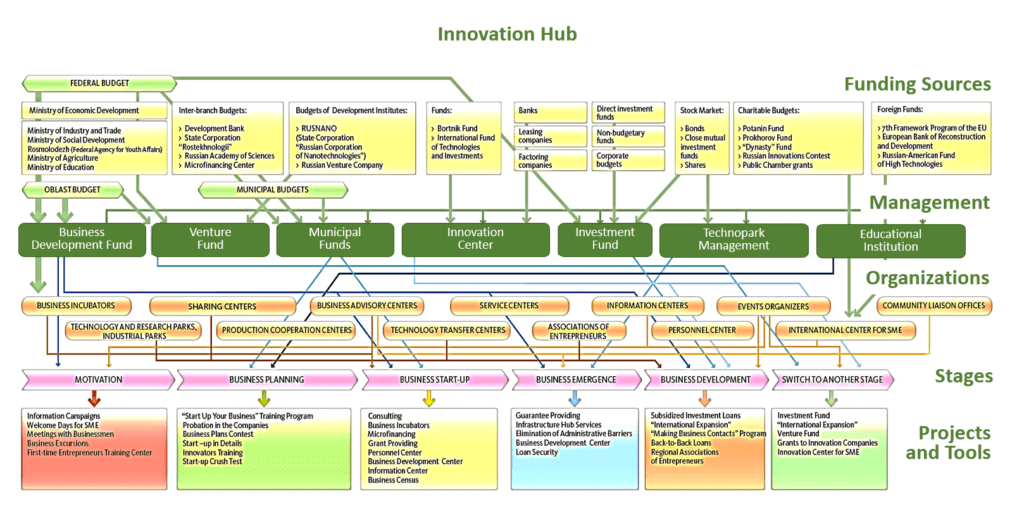
- I had a unique opportunity to develop and lead the largest stage-gate innovation pipeline, which supported over 5,000 projects and was awarded as a national best practice.
- I secured over 50 million dollars of funding from public and private sources to build innovation-development infrastructure. I personally prepared all proposals, pitches, presentations, and defended all projects myself.
- I organized over 300 major events—innovation forums, investment forums, venture forums, startup forums, and many others—with innovators, inventors, investors, and more than a hundred thousand participants.
- And when I say “I organized,” “I led,” or “I ran,” I mean that I fully owned these projects from ideation to execution.
- I led the largest entrepreneurial and innovation infrastructure with business incubators, accelerators, innovation centers, special events, contests, funding instruments, and support programs.
- I led research projects, including global initiatives with 26 countries, and I developed a special format of Research Acceleration Events aimed at fostering research at universities and commercializing the results.
- I also founded my own startups—from telemetric equipment, medical technologies, and IT projects to international events, a paint plant, boat manufacturing, and consulting projects.
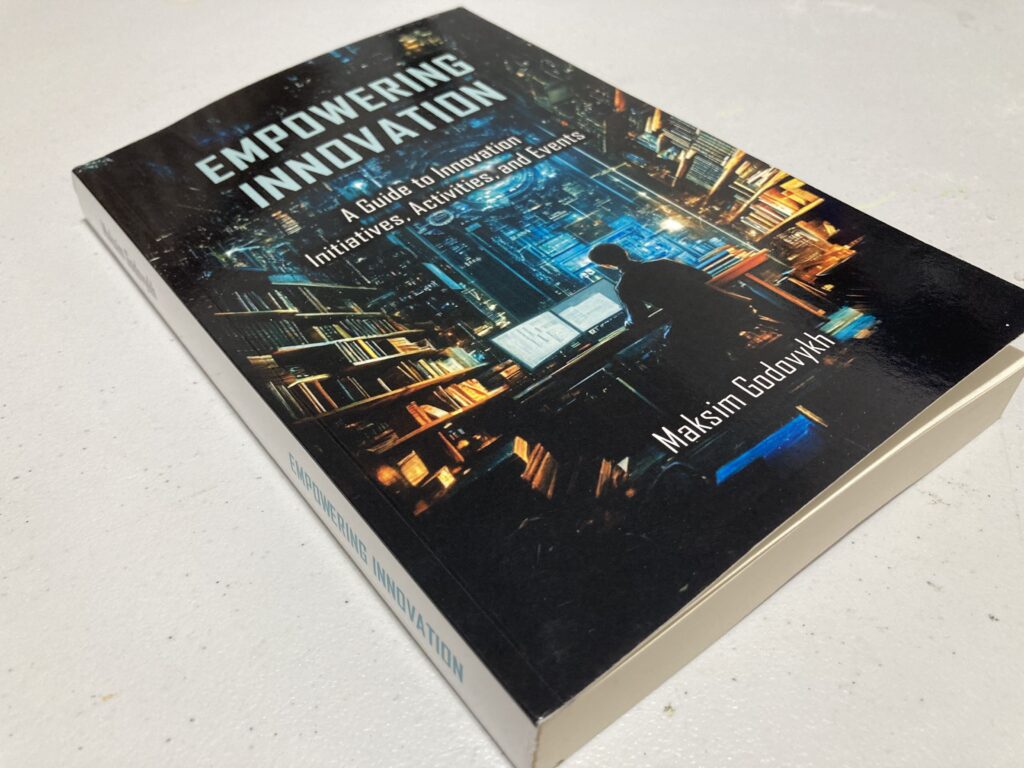
- I have published a lot on innovation, including my recent books Empowering Innovation and Research Acceleration. I developed educational courses, launched and supervised the Innovation Management Academy, and I am always happy to share my expertise with universities, businesses, governmental organizations, and other stakeholders.
My Approach to Innovation
I believe that the true driver of innovation is not simply the quality of ideas but the volume of projects, people, and organizations actively engaged in the process.
- If you ask me now about the most critical pillar of innovation development, it is definitely the infrastructure. Without structured pipelines to attract, evaluate, develop, and scale ideas, even the most promising concepts fail. The more ideas that flow into your system, the greater the chances of success. I was lucky to secure resources to build a large infrastructure of organizations, tools, and programs that supported innovation at every stage—and within a couple of years, it facilitated more than a thousand projects.
- Innovation events stand out as the most powerful tool. They provide a dynamic platform to gather, educate, and engage thousands of participants in a very short period. They bring together innovators, investors, policymakers, media, and industry leaders. If you want to accelerate innovation in your organization, region, university, or industry—start with an innovation forum. And make it open. Invite researchers, entrepreneurs, investors, businesses—even competitors. The larger the participation, the stronger the synergy, and the faster meaningful progress is made.
- The next pillar is education. Managing innovation requires a unique mix of competencies—idea generation, concept development, risk management, market research, prototyping, leadership, strategic execution. We lack many of these skills in traditional education. When our innovation pipeline expanded to hundreds of projects, this knowledge gap became a major barrier, so we launched an Innovation Management Academy and developed specialized training programs.
- The fourth essential pillar is collaboration. No single entity—even a well-funded one—can foster innovation in isolation. Innovation occurs at the intersection of disciplines, industries, and perspectives. Ecosystems thrive when researchers, entrepreneurs, investors, industry leaders, governments, and other stakeholders work together. The challenge is not just bringing people together but aligning interests, fostering productive interactions, and ensuring that collaboration leads to real, actionable outcomes.
- Another insight is that developing a single innovation component—such as a single incubator—without an interconnected system is one of the least effective ways to foster innovation. Innovation thrives in ecosystems where multiple elements—incubators, accelerators, co-working spaces, innovation centers, research acceleration units, and targeted events—work together to support projects at every stage.
I realize that my perspective may differ from traditional innovation-management textbooks, but it is based on my practical experience. And I believe that many of these tools can be implemented without significant financial, regulatory, or organizational resources—just with the energy and passion of motivated people.
Please fill out the form below to contact me.
I respond to all emails and all questions, and I’m willing to meet in person and discuss projects. I don’t like virtual meetings, so I’m always ready to drive or fly to meet and discuss ideas or initiatives.